Little Shop Of Horrors – Detailed Notes on the Guitar Book
Music: Alan Menken
Book & Lyrics: Howard Ashman
Year: 1982 (Off Broadway)
Little Shop of Horrors is a perennially popular musical for theatre groups all over the world. Funny, unusual and featuring those amazing puppets it has been keeping audiences amused for over 40 years. There have been numerous major revival productions and a 1986 film adaptation. The score is terrific, and the orchestration is small, at least for the original 1982 Off-Broadway version, which requires only a five-piece band. The small band size is a factor that makes the show attractive to smaller theatres, and I actually prefer the perky pop feel of the original orchestration over the more sophisticated, lush sound of the Broadway 10-piece version.
In this article I describe the shortcomings of the 1982 Guitar charts and how they compare to the parts heard on the 1982 cast recording. I also delve into the origins of the charts. From this context I describe my reassessment of the Guitar parts and how I approached preparing an updated version of the entire Guitar book. Finally, I provided detailed notes and tips on how to approach playing the material, with examples, including some of my own new charts for reference.
For clarity I should emphasize up front that this article is about the original 1982 Off Broadway version of Little Shop which has a 5-piece orchestration, not the 10-piece 2003 Broadway version, which has substantially revised arrangements. The 5-piece version of the show is performed far more often, and I hope this article will be helpful to the many guitarists and Music Directors who have to wrestle with the existing charts.
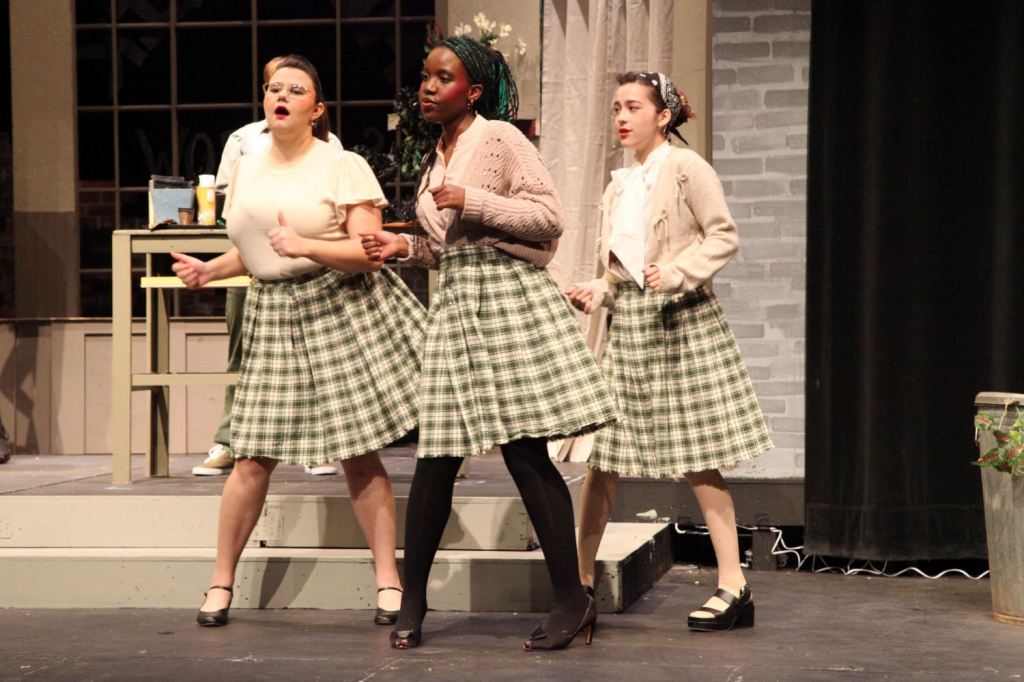
Crystal, Chiffon & Ronette – “Little Shop”
Image courtesy of Mercer Island High School and ©Alec Chvany
WHAT’S WRONG WITH THE 1982 LITTLE SHOP GUITAR CHARTS?
I first played Little Shop of Horrors in the summer of 2014, and recall being struck by the vague, untidy handwritten charts, and how they didn’t really match the parts heard on the cast recording that closely. I applied myself to developing a satisfactory performance of the book, thoroughly enjoyed playing what is a very charming show and thought no more about it.
All of the 1982 books are a bit of a mess, including Guitar. As the example below from the Guitar book shows, they are handwritten with a fairly thick pen, making features such as leger lines hard to discern. The penmanship looks hasty rather than neat and contributes to a book that’s difficult to read.
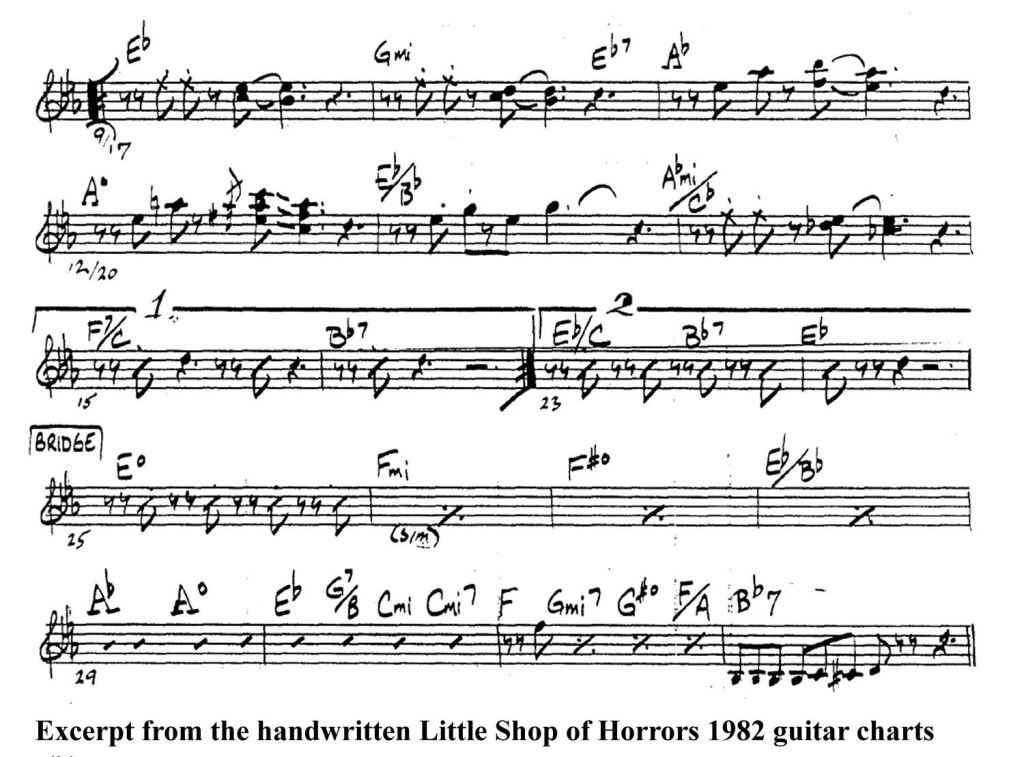
The structure of the charts is inconsistent. For example, some songs have playoffs as separate numbers, some have separate numbers but have measure numbering continuing from the main number, and some are just appended to the main number. Some of the books use repeats for second verses while others do not, for the same passage of music. Errors are plentiful. The books have also been poorly photocopied, so that parts of pages are missing (for example the left quarter inch of the first page of “Git It” is completely missing from the Guitar book.
Turning to the Guitar charts, they are vague in the way that a lot of Guitar books are, making extensive use of slash notation. There are many places where more detail on voicings and rhythms would have been helpful. Ultimately, you can’t play the show from the book without a lot of guesswork or, more likely, going back to the 1982 cast recording to understand the intent of the written part.
Sonically, my main issue with the Guitar book is that it makes generous use of heavy modulation effects such as flanging, which can be clearly heard on the cast recording. This works for a number like “Be A Dentist”, which has a kind of studied weirdness to it, but sounds distracting in the 60s doo-wop numbers such as “Skid Row”. The result comes across as something of an 80s take on 60s music. I dive into this subject in more detail throughout the article, but overall, my advice to anyone playing the show is to listen to some 60s music of this type and build some more appropriate sounds. I cover the subject of effects and equipment in general in more detail in a companion article, “Playing Little Shop Of Horrors – Guitar” (coming soon).
REVISITING THE 1982 GUITAR CHARTS
In November 2024 I had a second chance to play the show and used the opportunity to look more closely at the charts. This led me down a fascinating and time-consuming rabbit hole of discovery about the genesis of the guitar parts and charts, and ultimately to a revised set of typeset charts which I was able to road test and refine during the run of the show.
My first step in reassessing the charts was to read them through while listening on headphones to the 1982 cast recording. The guitar isn’t mixed particularly high, but it is quite clear that for most of the album there are two (and sometimes three) guitar tracks, panned mid-left and mid-right. The existing charts as a whole are a composite of the two tracks, although the majority seems to be taken from the mid-left side. This led me to wonder if the original Off-Broadway production had 2 guitars, which were combined to produce the materials now available. I was surprised to discover that the Off-Broadway production had no guitar at all.
The excerpt below from the 1982 Off Broadway Showbill shows that Little Shop had only four musicians (Piano, Keyboards, Bass & Percussion). A YouTube audience video of the production confirms that there was no guitar. So, when was the Guitar book added?
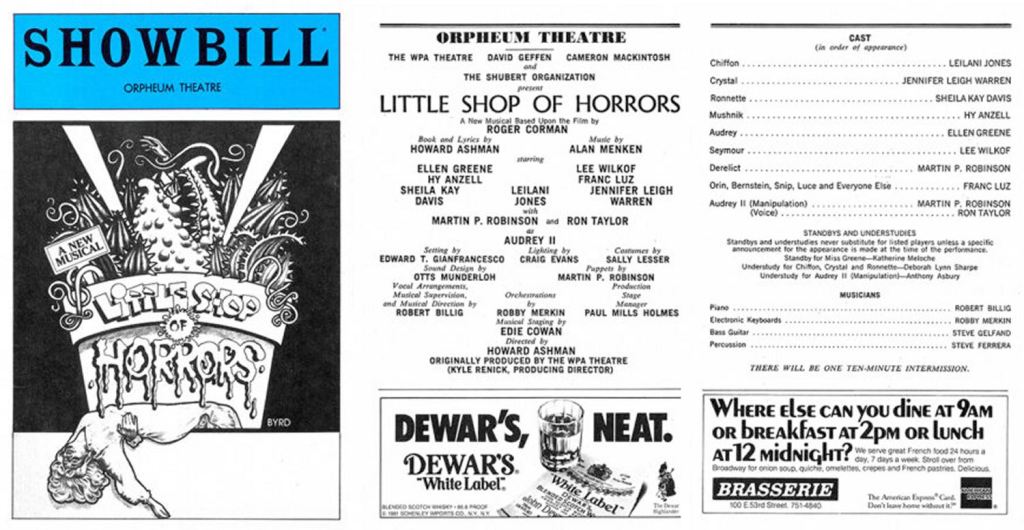
Pages from Little Shop of Horrors 1982 Off Broadway Showbill
Little Shop of Horrors premiered on May 6, 1982 at the WPA Theatre, transferring to the Orpheum from July 27, 1982. The Original Cast Recording was released on August 25, 1982. Media mogul David Geffen was a sponsor of the production, and the cast recording was issued by his record label, Geffen Records. It was expensively produced by a big league record producer, Phil Ramone, at his own studio and is the first appearance of guitar in Little Shop. The album’s guitar work is credited to the late David Brown, who was the guitarist in Billy Joel’s Band from about 1978 to 1991. Since Phil Ramone was producing a run of classic Billy Joel albums around that time, Brown would presumably have been an obvious choice for a session guitarist.
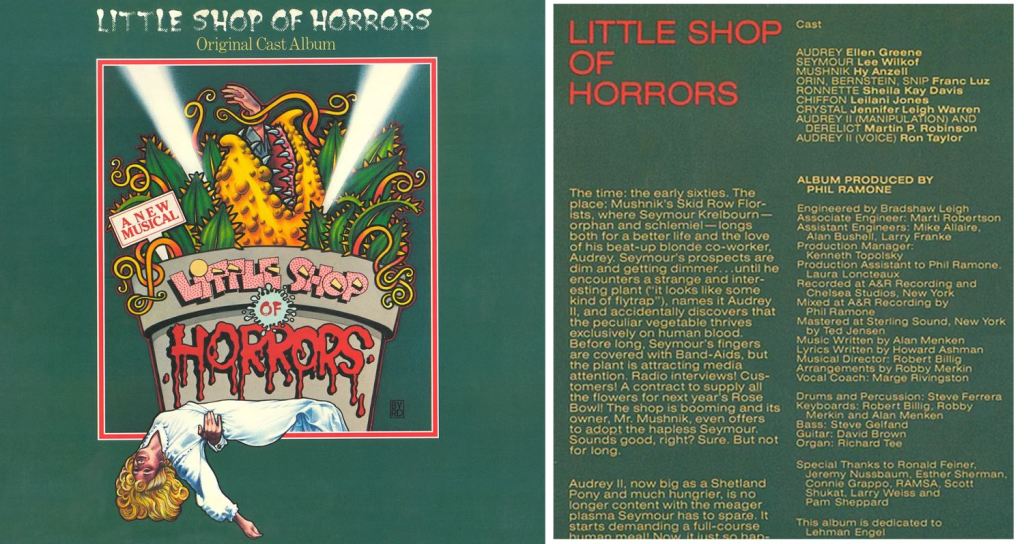
Little Shop of Horrors Original Cast Album Cover Art and Credits
A further clue to the genesis of the Guitar book is contained at the front of the book itself, which includes the following acknowledgement:
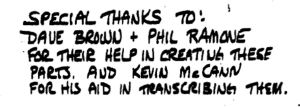
Reading between the lines, it seems that a production decision was made to add guitar to the cast recording, and that Alan Menken, Phil Ramone and Dave Brown worked out the guitar parts on the fly in the studio. The charts were transcribed from the recordings (or any rough charts produced during the recording sessions), and later added into the materials for the show. Their first use appears to have been in the London West End production, which opened in October 1983, as evidenced by the excerpt from the program below. The materials appear to have remained largely unchanged since.
An audience recording of this London production can be found on YouTube and the Guitar can be heard reasonably clearly. The guitarist’s performance comes across as a slightly under-rehearsed jazz musician’s take on the material and doesn’t work particularly well.
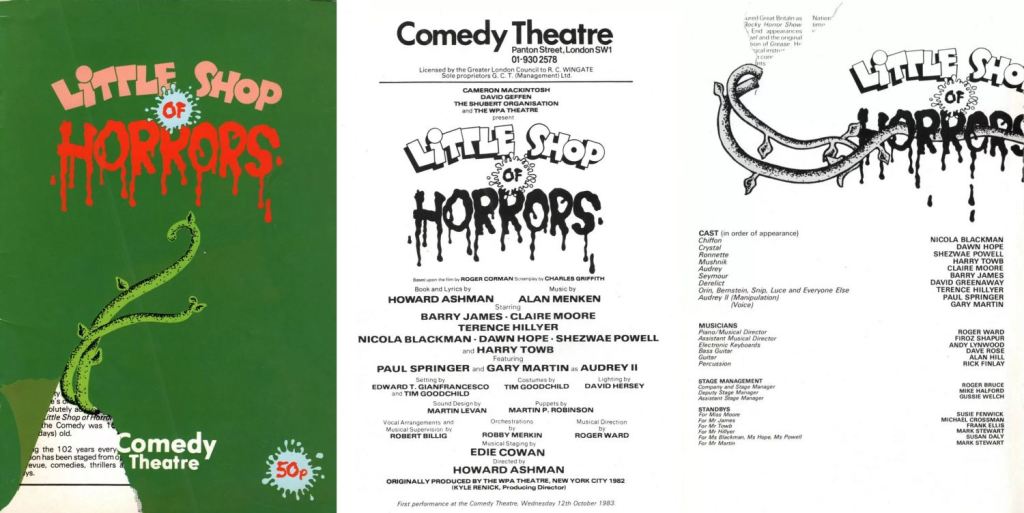
Pages from Little Shop of Horrors 1983 West End Playbill
With this context in mind, I compared the charts in the Guitar book to the multiple guitar tracks on the cast recording and concluded that they represent an attempt to synthesize a single part from the multiple guitar tracks on the recording. Some charts attempt to combine two tracks; when only one is used there seems to be a preference for the track on the left side of the mix. For some songs the charts bear little resemblance to the recorded parts. In particular, the chart for #9: “Mushnik + Son” is quite different from either guitar heard on the recording.
Having learned that the guitar tracks on the 1982 cast recording were in fact the source material, and the existing charts an only partially successful attempt to transcribe them I decided that, rather than merely producing typeset versions of the existing charts, I would undertake a full re-transcription based on the 1982 cast recording, with the broad aim of producing a high quality book that honors, improves on and is consistent with the material as expressed in the 1982 Off Broadway version of the show. I established the following approach:
- Structure of charts: the new, typeset charts would be consistent with the 1982 Piano Conductor score. This is not as simple a statement as it appears. Each of the 1982 books is slightly inconsistent with the others to some extent. The new Guitar book would at least be consistent with the PC score!
- Content: the charts would be based largely on the 1982 cast recording, combining and reproducing the parts more accurately than the existing charts. Where clarification was needed, I would refer to the updated Broadway orchestration, to all available cast recordings, and inevitably to my own experience playing the show.
- Electric guitar sounds: the charts would include more accurate and detailed information on effects and tones for the electric guitar. I also decided to modify the sounds to have less of an early 1980s bias towards heavy use of modulation effects (mainly flanger), and more use of “classic” tones (reverbs, tremolos & slapback delays for example), which suit the material. My recommendations for effects settings can be downloaded here.
- Errors: I would identify and eliminate errors in the existing charts.
- Detail: the new charts would a higher level of detail than the existing charts (e.g. using specific voicings), while maintaining ease of readability for performance.
- “Missing” charts: Guitar is Tacet for some numbers (especially tags and playoffs). I decided to review whether adding a Guitar part would be useful or appropriate for each of these numbers. For guidance I listened to other cast recordings, including the 2019 Off Broadway revival, and drew on my own experience. I assume that some of these numbers had no guitar part because they were not recorded for the cast album.
- Tempos: I decided to include tempos in all the charts (the existing materials have none at all). I used the tempos heard on the YouTube video of the 1982 Off Broadway production. For completeness I also tabulated the tempos heard on the 1982 cast recording, which differ in places from the live show. My tabulation of the tempos can be found here.
- Dynamics: I decided to add more extensive information on dynamics throughout the book.
- Cues: I would add more detailed vocal and musical cues to the book, to make it easier to follow during performance.
- Use of Repeats: I decided to eliminate the use of “convenience repeats” as far as possible (this is where repeats end up having multiple measure numbers and are only used to reduce effort in transcribing the charts). If a measure has a unique number, no repeat would be used.
I was very pleased with the completed charts. They are more accurate and easier to read than the originals, making the show easier and more satisfying to perform. I also had a chance to road test the charts in a November 2024 production, resulting in a few minor adjustments and corrections.
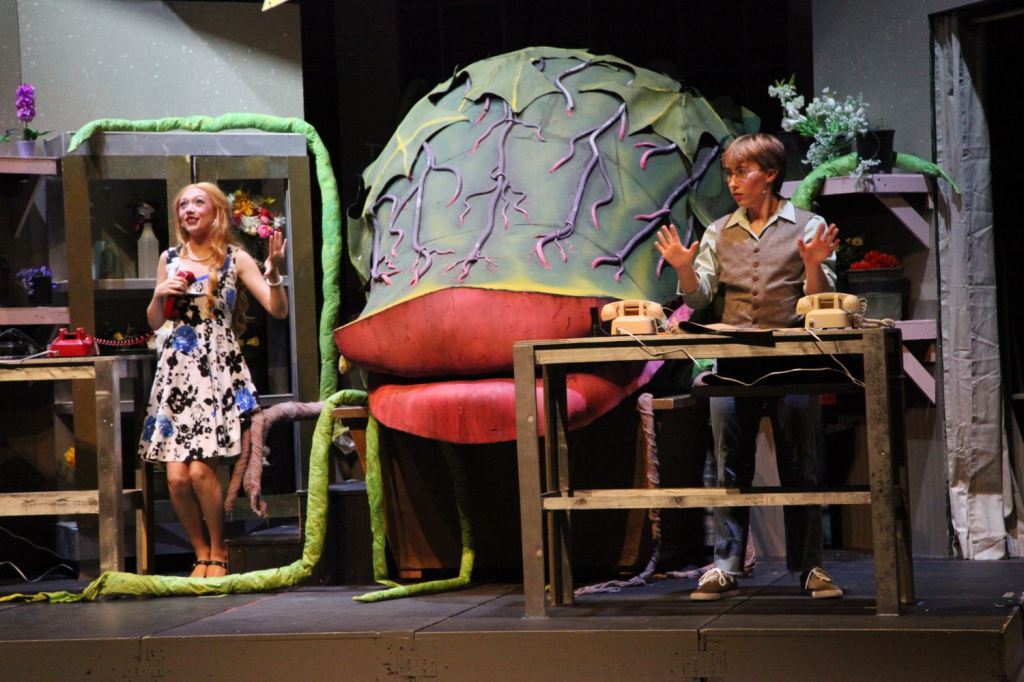
“Call Back In The Morning”
Image courtesy of Mercer Island High School and ©Alec Chvany
SONG-BY-SONG SPECIFIC NOTES
In this section I provide commentary on every number in the Guitar book except for those where Guitar is tacet. I also include suggestions for parts where I have departed from the 1982 book. As explained above I revamped the entire book to be closer to the 1982 cast recording, so these notes are very much my take on the book and the typeset excerpts are from my new versions of the charts. Hopefully they will be useful to anyone preparing to play the show. These note are intended to provide insight and ideas – they’re not a “manual” for playing the show. I identify all errors I have been able to find in the original book in the notes. A complete list can be downloaded here.
References to pickup settings are for a Strat-style guitar with three single coil pickups. Position 5 (Pos. 5) is Bridge pickup, Pos. 4 is Bridge + Middle, and Pos. 2 is Middle + Neck.
#1 – Prologue
Pickup: Pos. 5 – Bridge
Effects: Overdrive
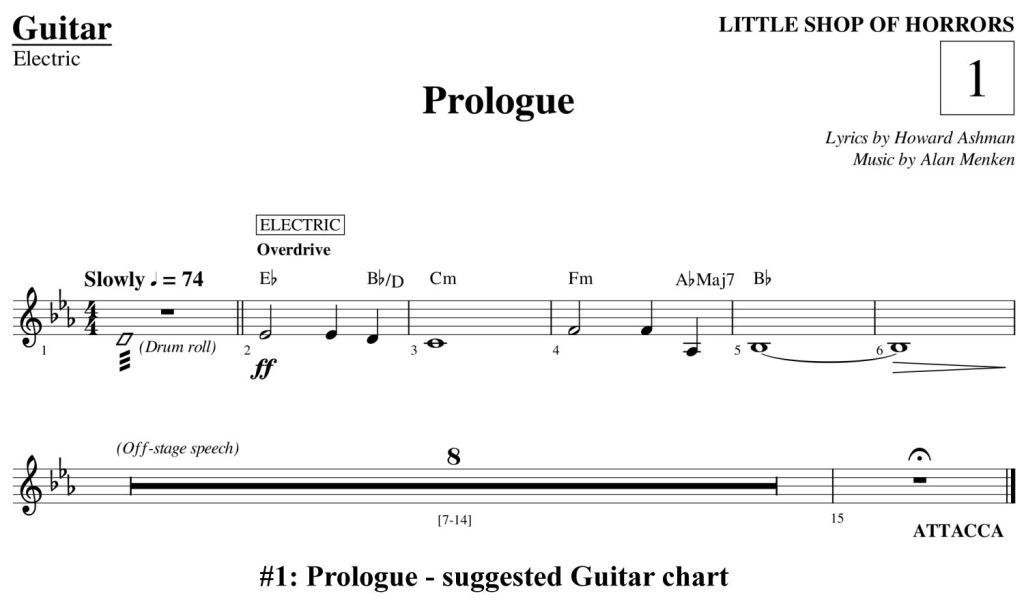
The show opens with dramatic fanfare, followed by underscore, leading into #1A: Little Shop. Guitar is inexplicably tacet; the fanfare is crying out for a big overdrive sound. I added a single note melody to m.1-5 (with Overdrive), then left the Guitar tacet for the underscore section, as shown below. This is the first of several such “big moments” in the show where adding guitar is an obvious thing to do. I suspect such absences occur mostly where the music was not recorded as part of the cast album, so no chart was made. However, in this case you can hear guitar in the fanfare on the cast recording. The chart can be downloaded here.
#1A: Little Shop
Pickup: Pos. 4 – Bridge + Middle
Effects: Clean + Chorus
I love this song. If there’s a more perfect pop song in the whole musical theatre repertoire I have yet to find it. Upbeat, with an impossibly catchy hook and it’s over so quickly that you’re left begging for more. Just wonderful. It’s a perfect 60s TV theme! The original chart recommends use of a Flanger in the Bridge section, but I switched this for a brighter sound of a light Chorus throughout the song. The bright chiming sound of a Strat Middle + Bridge pickup combination with the added Chorus lifts the whole sound of the ensemble.
The original chart is also in fairly good shape compared with some other parts of the book, except for the Bridge section, which lacks detail and is a little clunky to play as written. I transcribed the part from the cast recording more accurately, as shown below. Elsewhere, the chart calls for short, choppy chords, which doesn’t mean staccato, but rather bright, crisp voicings, using mainly the top four strings.

#2: Skid Row
Pickup: Pos. 4 – Bridge + Middle
Effects: Clean + Chorus
The joyous opening number is followed by another doo-wop pop song, but with a distinctly darker lyric. Again the chart calls for Flanger, but I recommend a light Chorus; Flanger is a little dark for these pop songs, and the whole point here is the contrast between the light, up-beat music and the darker lyrical content.
Tips / adjustments:
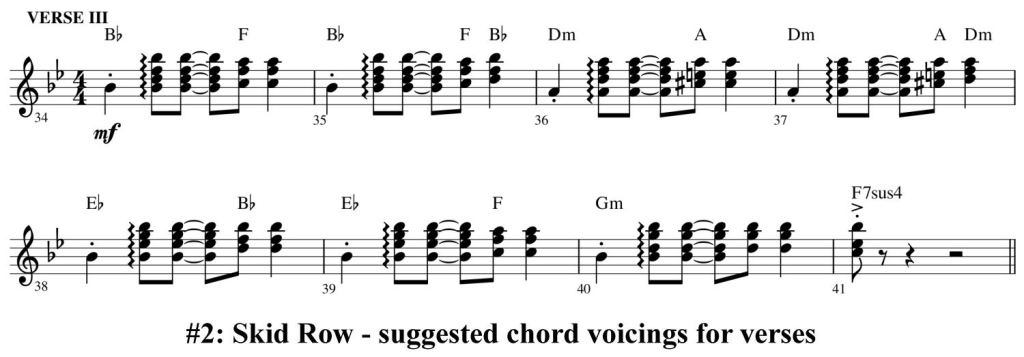
- Voicings: the chart uses slash rhythm notation throughout. For the verses (and indeed most of the song) I suggest medium-high voicings at the 5th and 6th frets, as shown in the excerpt below.
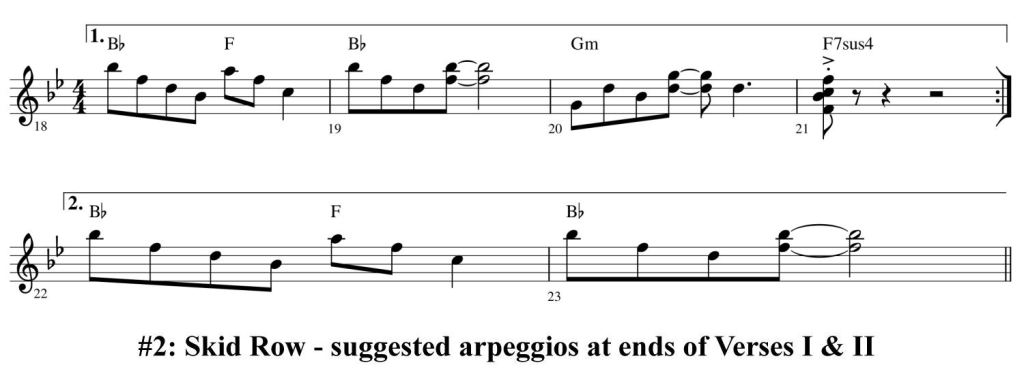
- m.18-21: the ending to Verse 1 continues the rhythm for the verse. I changed it to arpeggios, as heard on the cast recording and shown below. In this way the Guitar picks up the melody from the vocals between the verses.
- m.18: ERROR – missing chord symbol. There should be an F over the eighth-note at beat 3.5 (i.e. m.18 should be identical to m.22).
- m.22-23: this is the ending to Verse 2. As for Verse 1 I changed from rhythm to arpeggios, as shown below.
- m.32: I recommend playing this measure an octave lower than shown in the chart.
- m.38: ERROR – missing chord symbol. There should be a Bb over the eighth-note at beat 3.5 (i.e. m.38 should be identical to m.14).
- m.43: ERROR – missing chord symbols. Beat 3.5 should be F and beat 4 should be Bb (i.e. m.43 should be identical to m.35).
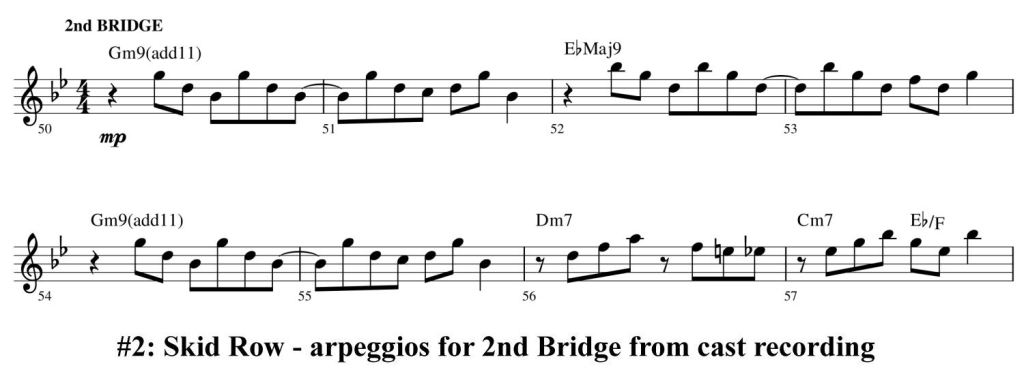
- m.50-57: the arpeggios for the 2nd Bridge are an approximation of the part on the cast recording. I provide a more accurate (and harmonically satisfying) version below.
- m.62: ERROR – incorrect note. Beat 3 should be a quarter-note, not an eighth-note (i.e. m.62 should be identical to m.58).
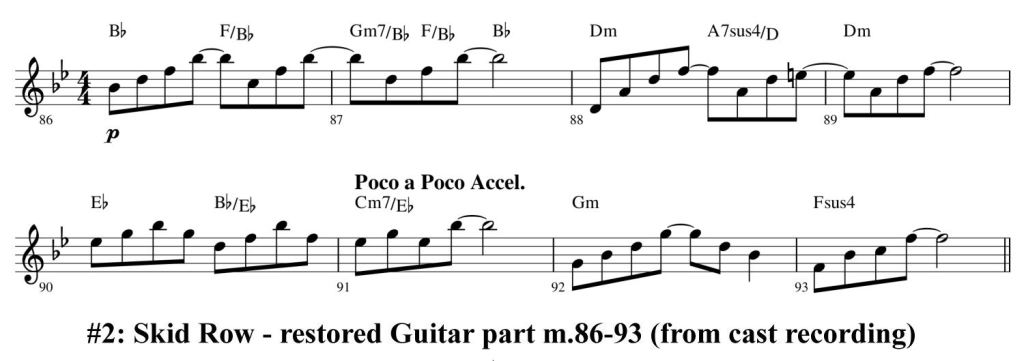
- m.86-93: this is part of the slower section where Seymour prays to get out of Skid Row. The chart shows Guitar as tacet, but the recording has nice picked arpeggios which help build the accompaniment. I added them back into the part, as shown below.
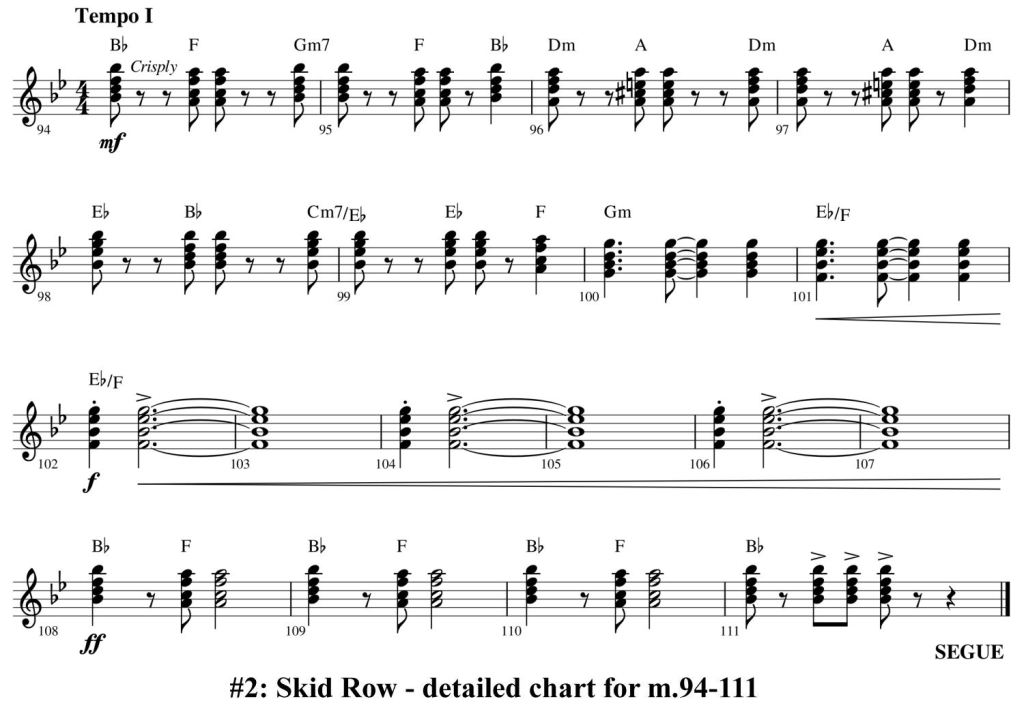
- m.94-99: the rhythm as written (similar to earlier verses) is incorrect. It does not match the rest of the ensemble. The correct rhythm is shown below.
- m.100-111: the chart is extremely vague in this final section of the song, with some measures showing only a chord symbol and no rhythm at all. I provide a full transcription below.
#3B: Da-Doo
Pickup: Pos. 5 – Bridge
Effects: Clean, Slapback Delay + Tremolo
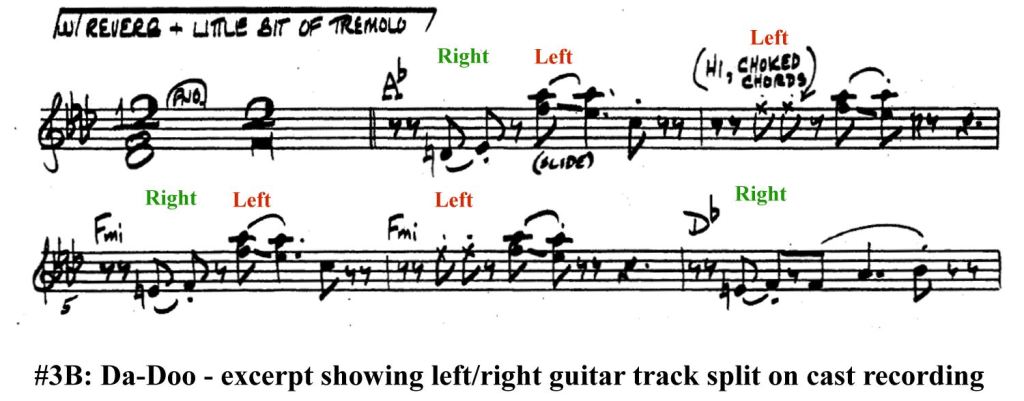
More 60s doo-wop pop, this time in 12/8 time. The chart calls for “reverb + little bit of tremolo”. I recommend a Slapback Delay with light Tremolo – a classic 60s sound. This is an odd chart. Like many in the book it represents an attempt to combine two guitar tracks from the cast recording. The low notes are generally from the right side guitar track; the high notes and choked chords are from the left side, as shown below. The result is a chart that’s not very easy to play fluently, because you end up having to jump up and down the neck almost every measure.
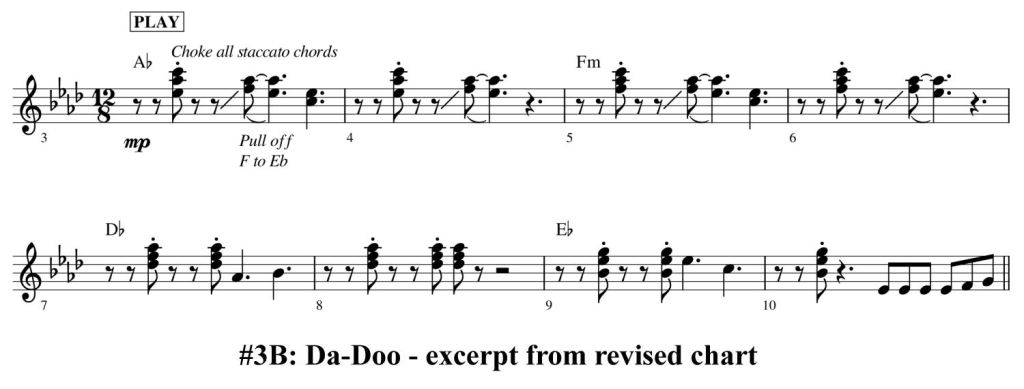
Ultimately it’s the high rhythmic part that’s more prominent. I prepared a chart which favored the high right side part and reproduced the recorded track a little more accurately, using the lower left side part as needed and where practical. I provide an excerpt below, and the full chart can be downloaded here.
 #4: Grow For Me
Pickup: Pos. 5 – Bridge
Effects: Clean, Slapback Delay + Tremolo m.9-47, Distortion m.48-51
Another 12/8 doo-wop song. Like #3B, this chart is an attempt to combine two guitar tracks from the cast recording, with limited success. I rewrote this chart in its entirety; it can be downloaded here. For those who wish to use the existing chart I provide the following tips.
Tips/adjustments:
- Title: ERROR – the name of the song should be “Grow For Me”, not “Good For Me”.
- m.12: ERROR – the chord should be F#dim7/A, not Adim.
- m.23: ERROR – the first chord in the measure should be F7/C, not Eb/C.
- m.43: ERROR – the chord should be F#dim7/A, not Adim.
- m.47: ERROR – missing chord name – Bb7 for the whole measure.
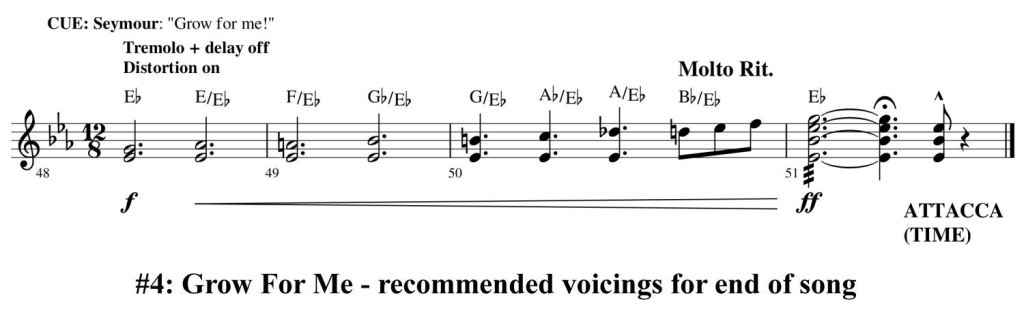
- m.48-51: for the last four measures, change to a distortion sound for the plant’s sudden dramatic growth spurt. I also recommend simply playing power chords for this section as shown below, rather than the syncopated rhythm shown in the chart.
#5 – You never Know
Pickup: Pos. 5 – Bridge
Effects: Clean + Chorus
This number comprises a swing jazz section, switching to a fast, light pop reggae-ish feel from m.81. The charts for the jazz section are a mess, with each instrument’s chart making different use of vamps and repeats throughout. Somehow all the books come together and manage to start the reggae section at m.81, but before that there is real chaos in the charts. There’s a one beat pickup measure before m.1, which only appears in the PC book; then the various books all use different combinations of repeats to get through the section – the measure numbering is almost impossible to tie together from book to book. m.23-26 are completely missing from the PC book, and at the end of the jazz section in m.78, the Bass, Guitar and Drums books have a 1/4 measure, while the PC and Keyboards books have a 4/4 measure. Mercifully for guitarists, Guitar is tacet throughout the jazz section. Nevertheless I updated the jazz section to match the PC book.
Once again the chart is a synthesis of two guitar tracks heard on the cast recording. Chord voicings should be trebly, bright and crisp.
Tips/adjustments:
- m.132: the C7 should be a whole note chord (4 beats).
- m.140: not a repeat of m.139. Play an eighth-note Bb chord on beat 1, then a single note walk-down F to E to D on beats 2, 3 and 4 respectively.
- m.148: ERROR – the F7 chord on beats 3 and 4 should Am.
#5A – You never Know (Playoff)
Pickup: Pos. 5 – Bridge
Effects: Clean + Chorus
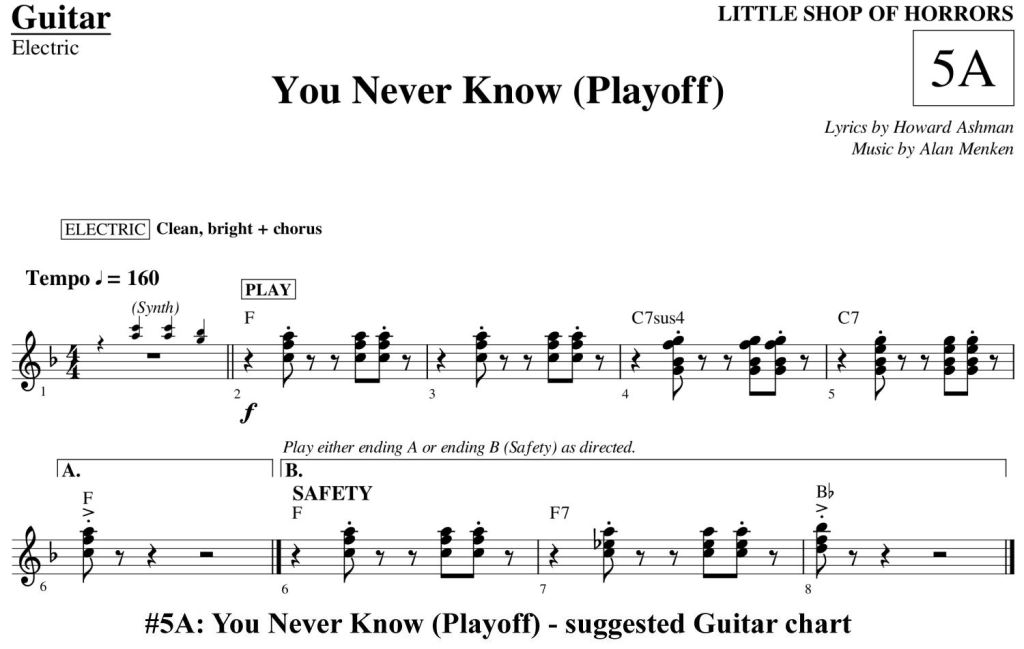
Even the chart for this simple playoff manages to be confusing. It has 8 measures, but there are two measures numbered m.6. The idea is to have the option of a shorter or longer playoff. You either play m.1 to the first m.6, or play m.1 to m.5 and then the second m.6 to m.8. My version of the chart clarifies the structure and is shown below.
#6 – Somewhere That’s Green
Instrument: Acoustic Guitar
This is a beautiful, heartfelt little ballad but like so many songs in this show it has a sting in the tail. Audrey sings about her dream life and her wish list is so abjectly pitiful it’s almost painful, which is partly the point of the song. Darkly humorous, or a barbed comment on inequality? Either way it’s a great song.
The Guitar chart is very vague. In summary Guitar should come in from the second verse onwards (m.51), starting with finger-picked arpeggios building to full, broad strummed chords for the bridge (m.67-74), and ending with more delicate arpeggios for the Outro (m.92-95). Pay special attention to the variation in dynamics as you rehearse the number. They are missing from the chart but important in making the song work.
Tips/adjustments:
- m.64: ERROR – chords should be Dsus4 for beats 1 &2, D for beats 3 & 4.
- m.69: ERROR – beat 3 should be Dsus4, beat 4 is D.
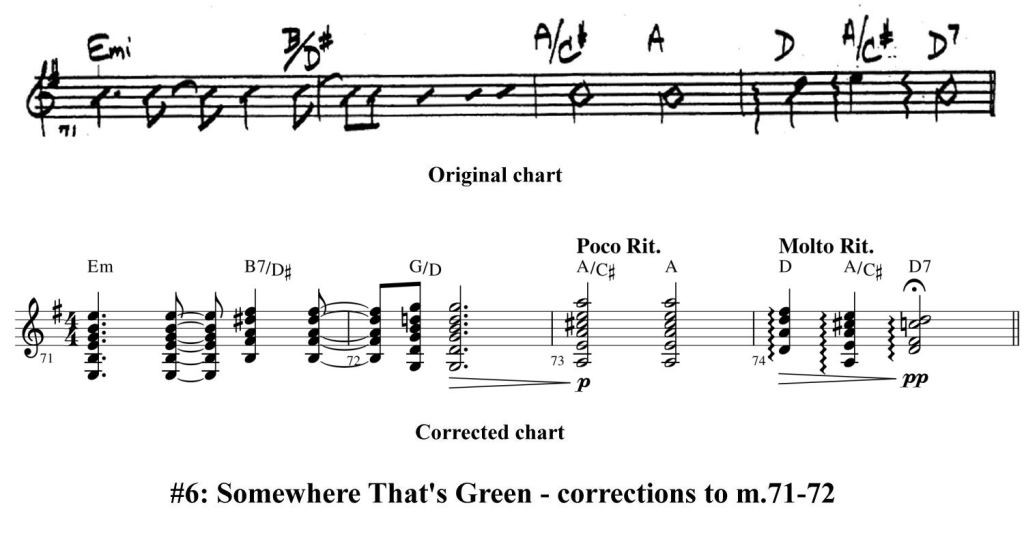
- m.71-72: ERRORS – the B7/D# should be over the preceding note. m.72 should be a G/D chord, as shown below (also note the dynamics and tempo changes added – there is so much information missing from the original charts!).
- m.92: ERROR – beat 4 should be D/G, not G.
#7 – Closed For Renovation
Guitar is tacet throughout this number. I tried adding a part based on the one in the 2003 Broadway orchestration, but it didn’t really add anything to the song, so I abandoned the attempt.
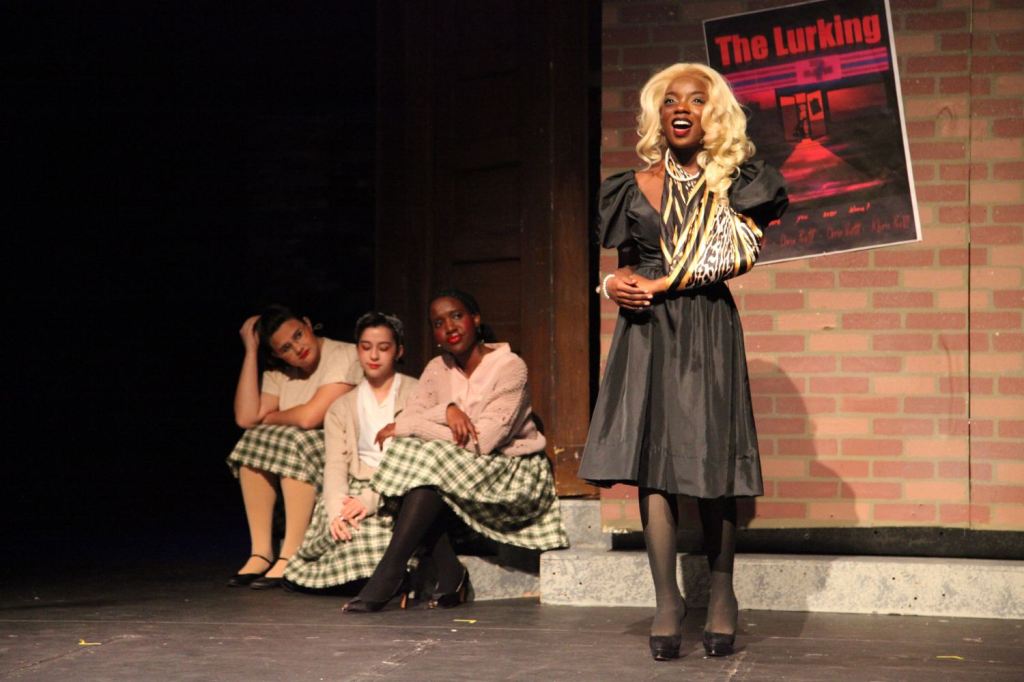
“Somewhere That’s Green”
Image courtesy of Mercer Island High School and ©Alec Chvany
#8A – Be A Dentist (Prologue)
Pickup: Pos. 5 – Bridge
Effects: Overdrive
This is a short four-measure Tag for Orin’s entrance. I played it as written, although there is an error!
Tips/adjustments:
- m.1: ERROR – the A on the last beat of m.1 should be a C.
#8B – Be A Dentist (Song)
Pickup: Pos. 5 – Bridge
Effects: Flanger (m.3-20, m.35-46), Slapback Delay (m.21-34, m.47-86)
This chart is in pretty reasonable shape. It calls for a Flanging effect throughout; I used Flanger for the verses only, substituting a Slapback Delay in the choruses.
Tips/adjustments:
- VERSES: the single-note part in the verses should be palm-muted. The score calls for “syncopated accents” but does not say which notes should be accented. The excerpt below shows where the accents should be.
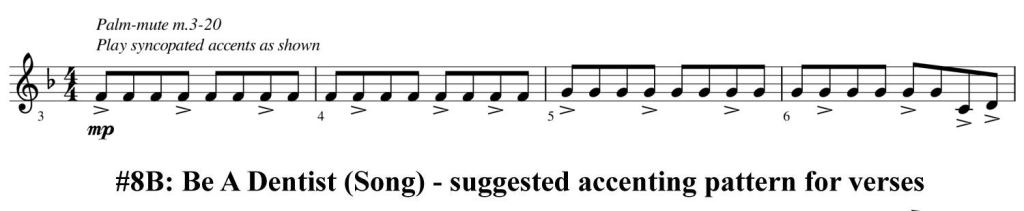
- CHORUSES: use voicings around the 5th fret, on the top 3 strings. The arrows above the chords in m.21 indicate that each pair should be played as an upstroke and downstroke.
#9 – Mushnik + Son
Instrument: Acoustic Guitar
This is an odd chart. The cast recording (remember, the Guitar book was developed from the parts added during the recording) has two parts. On the left side of the mix is a strummed rhythm part, played on an acoustic instrument that sounds like a cross between a mandolin and an acoustic guitar, so maybe a bouzouki. On the right is an electric guitar with flanger, playing rhythm in the verses and arpeggios in the choruses. The chart provided uses neither of these parts. Instead it calls for a shaker in the verses (which is indeed present on the recording) and a syncopated electric guitar chordal rhythm in the choruses. Moreover, the rhythm as written doesn’t really make sense in the context of the song.
I decided to replace the chart completely with an acoustic guitar part that closely matches the “bouzouki” part heard on the cast recording. It fits better and drives the song along nicely with the drums. I am aware of other productions having taken a similar approach, while others have opted to use a mandolin, based on the approach taken in the 10-piece orchestration for the 2003 Broadway production. The 2019 Off Broadway revival cast recording opts for an acoustic guitar playing a faux-flamenco style in the first verse, switching to ringing, overdriven electric guitar chords in the second verse (which I really didn’t like). My chart can be downloaded here.
#10 – Sudden Changes
Guitar is tacet.
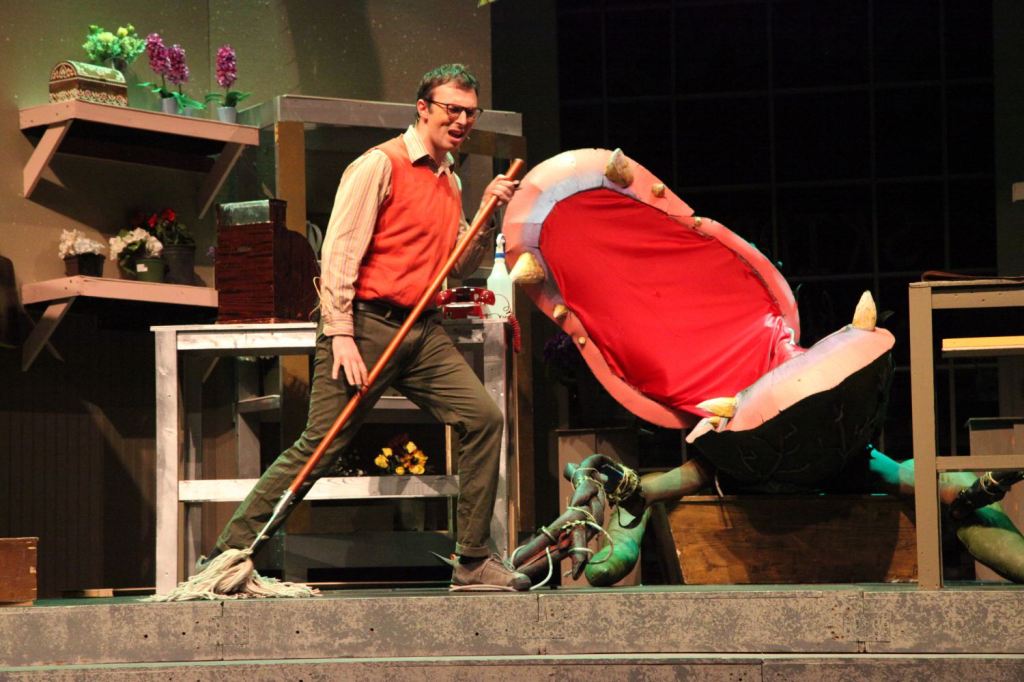
“Git It!”
Image courtesy of Mercer Island High School and ©Alec Chvany
#11 – Git It
Pickup: Pos. 2 – Neck + Middle
Effects: Compressor + Light Overdrive (m.1-33, m.44-53, m.58-59), Compressor + Overdrive (m.34-43, m.53-57, m.62-78)
Carnivorous plant Audrey 2 finally reveals that it can talk, and delivers this terrific funk/blues number. This is another song which advances the plot: Seymour is seduced into a Faustian pact by the plant. The structure is unusual. There is no chorus as such; rather there’s a series of verses interspersed with bridges, most of which are variations on the same theme. So, every time the song comes back to the verse it feels like the chorus. The actual song structure is:
- Intro
- Verse 1
- Verse 2
- Bridge 1 (bluesy)
- Verse 3
- Bluesy guitar solo section
- Verse 4
- Bridge 2 (double time rock feel)
- Coda (the bridge again but longer)
I used a Light Overdrive sound for most of the number, providing just a little break up in the tone on the attack. For the Bluesy solo, Bridge 2 and Coda I used a full on Overdrive. Pickup position 2 provides a warmer tone for the bluesy feel, contrasting with the bright tones for pop numbers in other parts of the show.
The chart is (once again) an attempt to synthesize the two guitar parts heard on the 1982 cast recording into a single manageable part. One of the challenges here is that the Guitar part for much of the song (all the verses and the solo) consists of improvised licks, which are difficult to transcribe. Let’s look at this a little more closely, using the first half of Verse 4 as an example (m.45-48). In the diagram below, the first line is an excerpt from the original handwritten guitar chart. The two lines beneath that are what can he heard on the cast recording, while the bottom line is my revised version of the chart. The two recorded guitars are jammed parts weaving together to create an overall funky groove, which is obviously impractical for one guitar. The original chart attempts to give a sense of a 16th note funk rhythm with the ‘x’ notes. In my revised chart I opted just to use slash marks with a note to play “funky, bluesy choked licks”.
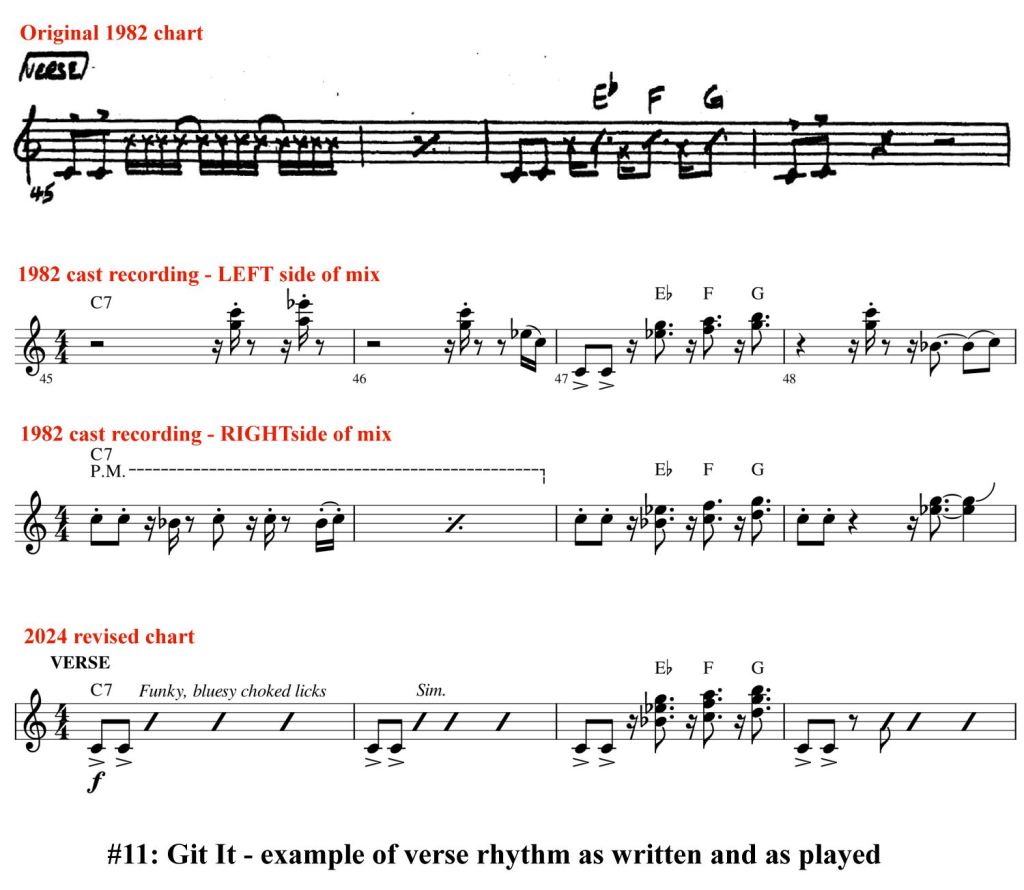
I recommend listening carefully and playing along to the cast recording to get a sense for the bluesy licks in the verses – the guitarist in the 1983 London live recording does a poor job of this! The licks are actually quite straightforward to play, as shown in the video clip below. It’s all done around the 8th fret (we are in C Major) and you just have to jam it out until you feel comfortable improvising it. That’s really the key for the whole song. Play it until you’re comfortable and feel it. Make the performance your own. I tend to play this number slightly differently every performance, and the song allows you to do that.
Tips/adjustments:
- ERROR – the left ¼-inch of the chart is missing on page 1, presumably due to a copying error made over 40 years ago!
- Effects: the chart calls for use of wah-wah on the verses. I don’t recommend this. Stick with a light overdrive.
- m.1-12: the chart has rests for the last three beats of each bar in Verse 1, but I recommend playing some light funky rhythm as described above. Again, listen to the cast recording.
- m.26-29: the chart calls for this lick to be played in a “slide guitar style”, because the original recorded part was actually played with a slide. Use glissandos to get the desired effect.
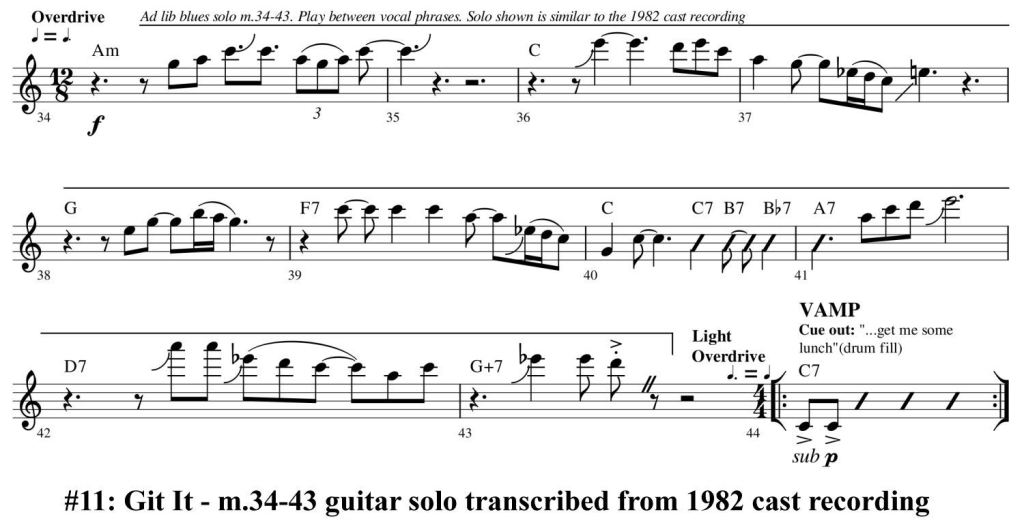
- m.34-43: the chart calls for an improvised blues solo. I switched to a full overdrive sound for this. The general idea is that the solo licks fall between the vocal phrases. I reproduce the solo heard on the 1982 cast recording below.
- m.53-57: double time rock feel. Again I switched to overdrive for this section.
- m.58-62: this whole series of vamps and repeats has to be timed with the action and dialogue on stage.
- m.58: the chart says to play 3 times, but really this is a VAMP and the cue out is Audrey 2 saying “Sure you do”.
- m.59: the chart says to play 2 times, but again it’s a VAMP and the cue out is Orin saying “You dizzy cow”.
- m.60: VAMP in 2/4. Cue out is Orin slapping Audrey, and the slap is the downbeat of m.61.
- m.61: play twice, then go on to the rock section.
- m.62-78: the rest of the song is double time rock with full (rather than light) overdrive. I played the F power chords inverted (F over C instead of C over F). At m.76, play a high solo lick.
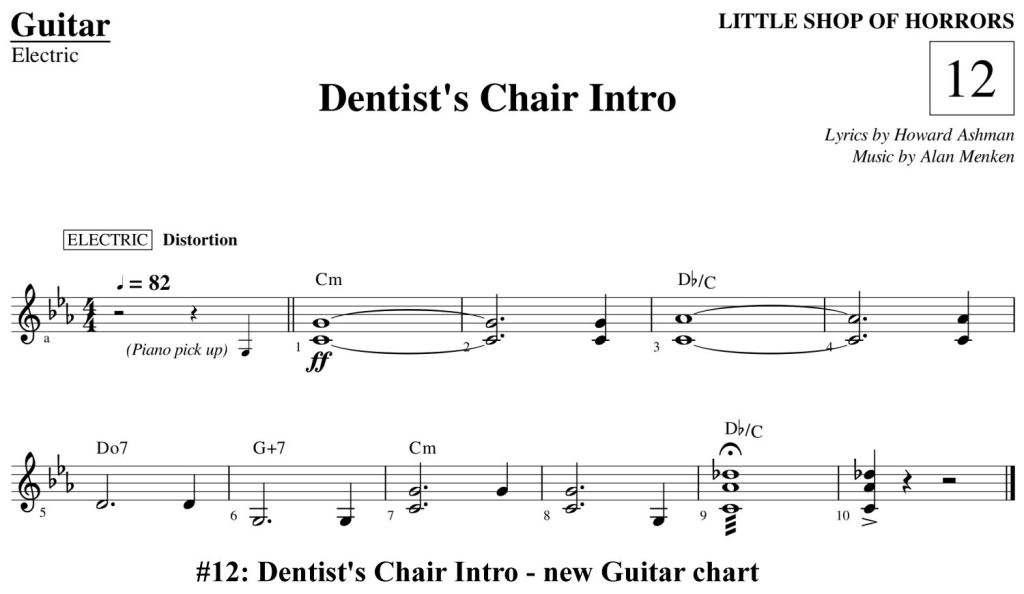
#12 – Dentist’s Chair Intro
Pickup: Pos. 5 – Bridge
Effects: Distortion
This is a chart this I added to the score. It’s a short scene change piece, a doom-laded fanfare which suits big distorted power chords. My chart appears below, and can be downloaded here.
#13 – Now (It’s Just The Gas)
Guitar is tacet, but be ready for the direct segue into #13A: Coda.
#13 – Coda
Pickup: Pos. 5 – Bridge
Effects: Distortion
Act 1 concludes with another doom-laden dramatic flourish as Seymour feeds the dentist to Audrey 2. This is all big distorted power chords.
Tips/adjustments:
- m.57: let the C(no3) chord ring through m.58-59. Similarly, let the chords in m.60, 62 & 64 ring through m.61, 63 & 64 respectively.
#14 – Call Back In The Morning
Pickup: Pos. 5 – Bridge
Effects: Light Overdrive
After a brief prelude fanfare in m.1-5 (a reprise of the “Grow For Me” theme), this short but very fast number depicts the frenzy of activity in Mushnik’s now busy shop. It isn’t included on the 1982 cast recording. The tempo on the cast recording is 192 (very fast) and the song is in F# Major – 6 sharps, which is not ideal for a guitar!
The Guitar part is odd. It’s almost as if they couldn’t work out what to have the guitarist do during the verses; the chart calls for muted notes “in upper register for electronic sound”. Notes with cross heads are provided as shown below, but they are clearly not what you’re supposed to play.
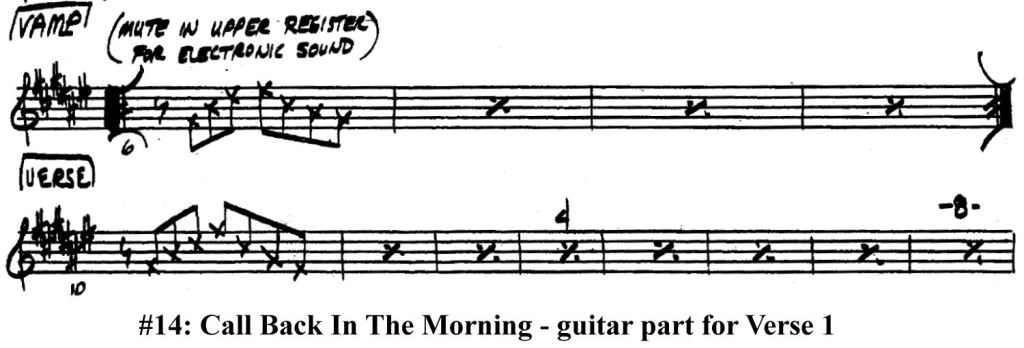
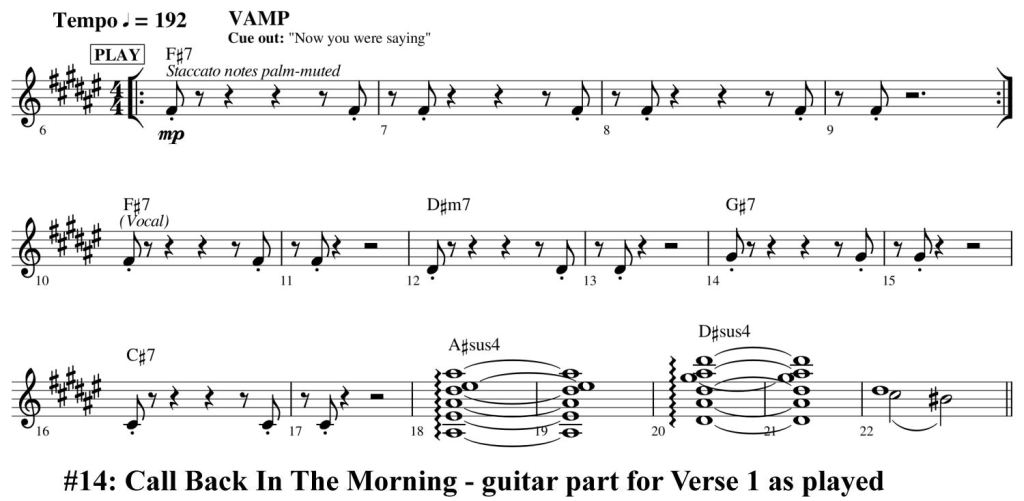
There are a few options: you could play completely atonal clicks (which seems pointless). High F# palm-muted arpeggios would work, or you could duplicate the arpeggios of the piano part (again, high and palm-muted). I opted for playing something similar to what’s heard in part of the 2019 New Off Broadway Cast Recording, which is to play notes at the beginning and end of each measure, which provides emphasis to the patterns being played by the Piano.
Tips/adjustments:
- m.18-55: the middle section of the song is played exactly as written. It’s not difficult but note that it has to be played an octave higher than written so it gets pretty high up the neck.
- m.56-67: for Verse 2, I played the same pattern as Verse 1, as shown above.
- m.76-77: the score calls for a C# harmonic. You can achieve this at the 9th fret on the A-string, but it won’t really ring out. I recommend playing a high C# and letting it ring through m.76 and 77.
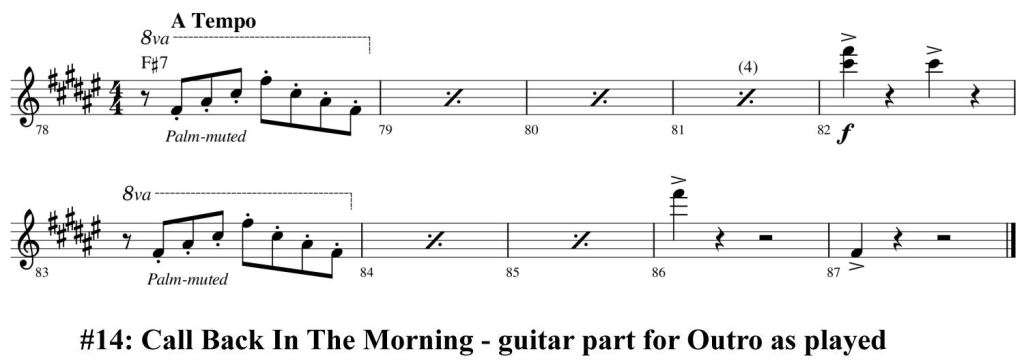
- m.78-87: for the Outro, I opted for high palm-muted F# arpeggios, as shown below.
#15 – Suddenly Seymour
Instrument: Acoustic Guitar
Another lovely ballad and the most famous number from the show. This is always a highlight. The arrangement is simple but very effective, building steadily from just a piano to the full band. Guitar doesn’t come in until Verse 3. On the cast recording the arrangement is a little different, and Guitar starts at Verse 2. During rehearsals I experimented with having the Guitar come in early, but it actually detracts from the arrangement.
Tips/adjustments:
- m.56-65: for the verse, chord voicings should be used which keep A as the top note in the voicing throughout. I settled on a specific set of voicings which suit the feel of the songs very well, as shown below – not the easiest to play but very effective. You can switch to more standard voicings for the chorus.
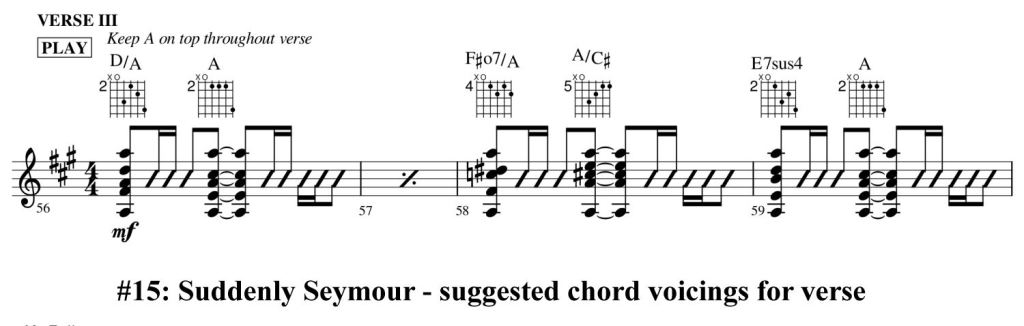
- Dynamics: the charts are woefully lacking in dynamics. I suggest mf starting at m.56, with a crescendo at m.65, forte from m.66 (the chorus), subito piano at m.78 building back to forte at m.80, then ff from m.84 to the end.
- m.58: ERROR – the B#o chord should be F#o7/A.
- m.62: ERROR – the B#o chord should be F#o7/A.
#16 – Suppertime
Pickup: Pos. 5 – Bridge
Effects: Overdrive (m.1-34, 56-59, 76-81), Delay + Reverb (m.36-54, m.102-106), Clean (m.60-74), Long Delay + Reverb (m.84-100), Distortion (m.107-109).
A dramatic sequence culminating in Mushnik being eaten by Audrey 2. There’s a lot of changing guitar sounds in this number. The most important effect is the delay used in the verses. I used a quarter-note delay (about 270ms) with 2-3 repeats.
Tips/adjustments:
- m.3: this should be a G5 chord with high G as the top note.
- m.23: this should be a D5 chord (not Dm) with D as the top note as shown.
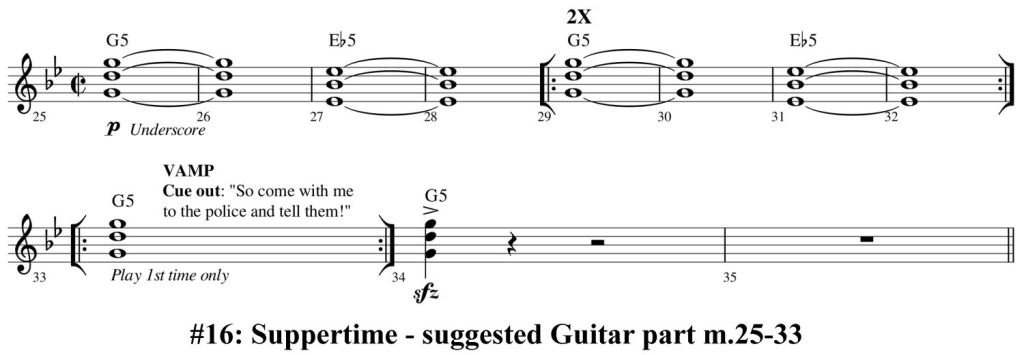
- m.25-32: the Guitar score shows 4 measures of rest, played 3 times (2 repeats). However, the Piano Conductor score has m.25-28 played once and m.29-32 played twice (one repeat). I added quiet power chords for Guitar into this section, as heard on the cast recording and shown below.
- m.33: this should be labeled as a vamp. Play a G5 power chord first time only and hold until it fades out.
- m.34: play a G5 power chord with high G as the top note, as shown below.
- m.36-54: this verse should be played as palm-muted eighth-notes with a quarter note delay and some reverb. The part shown in the score is a little vague. Below I show a typical pattern which fits the material.

- m.41: ERROR – the Gm/Bb chord name should be above m.42, not m.41.
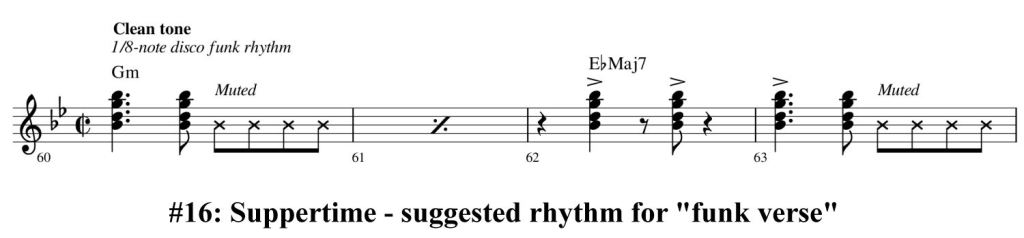
- m.60-75: this is described as “funk verse (choked)”. The rhythm pattern provided is once again vague. The excerpt below shows how I played m.60-63 – repeat the pattern in the following 12 measures.
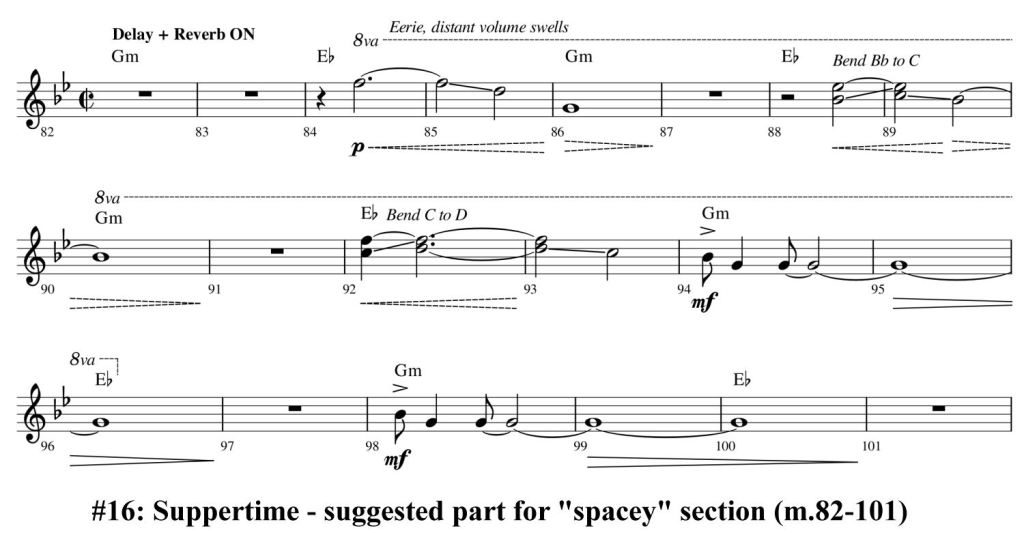
- m.82-101: the chart is vague once again here. I recommend listening to the cast recording to get a sense of what to play. It should be a big reverb and a long delay (I used 450ms with 2-3 repeats) to get a “spacey” sound. Use volume swells to remove the attack up to m.93. I played this as shown in the excerpt below.
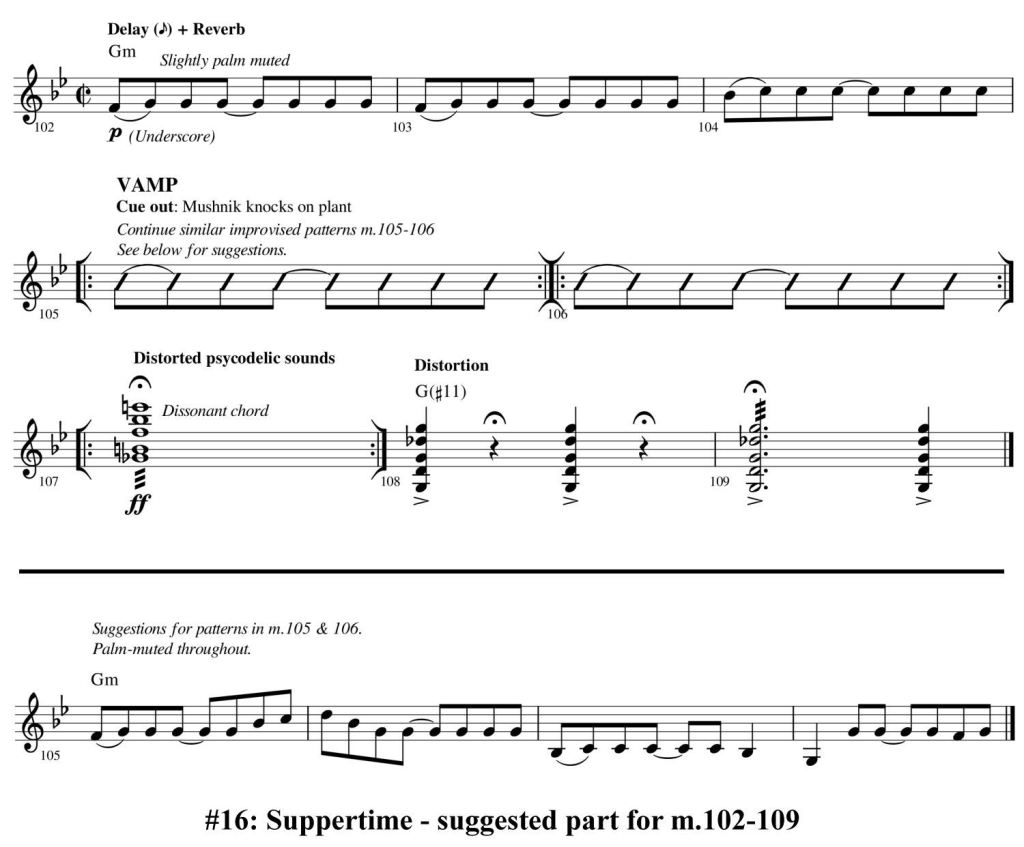
- m.102-109: the chart here is very difficult to follow and does not match the Piano Conductor score. In essence you play a slightly palm-muted eighth-note pattern (similar to m.36-54) for m.102-104. Continue ad libbing a similar pattern through m.105 (VAMP) and m.106 (repeat, but may be a VAMP depending on timing of stage actions). At m.107 switch to distortion and play a dissonant chord. When directed, play m.108 and m.109 (all of m.107-109 is dictated). For clarity, I include a re-transcribed version of this whole section below, together with suggestions for the “ad lib” vamps in m.105-106.
#17 – The Meek Shall Inherit
Pickup: Pos. 5 – Bridge (also uses Acoustic Guitar)
Effects: Slapback Delay (m.40-105), Flanger (m.204-219), Distortion (m.220-233)
Seymour is courted by a procession of commercial interests as he wrestles with his guilt. There are three piano-led verses where walk-on characters pitch business ventures to Seymour. The Guitar chart uses a series of repeats to reduce the length of the chart but of course (as usual) it’s not entirely consistent with the Piano-Conductor score. Nevertheless, it’s pretty obvious where the cue for the guitar to play at the end of each verse is.
Tips/adjustments:
- Choruses (m.40-52 and m.94-106): play short choppy chords with a bright clean sound. No effects are called for but I added a Slapback Delay, which worked well.
- m.160-194: this section is played on Acoustic Guitar and has a military march feel. Play out (it’s loud) and make sure the triplets are crisp. Listen to and keep tight with the drums. At m.193, play the Asus4 chord with Tremolo and gradually fade out.
- m.172: ERROR – the B/D chord should be B/D#.
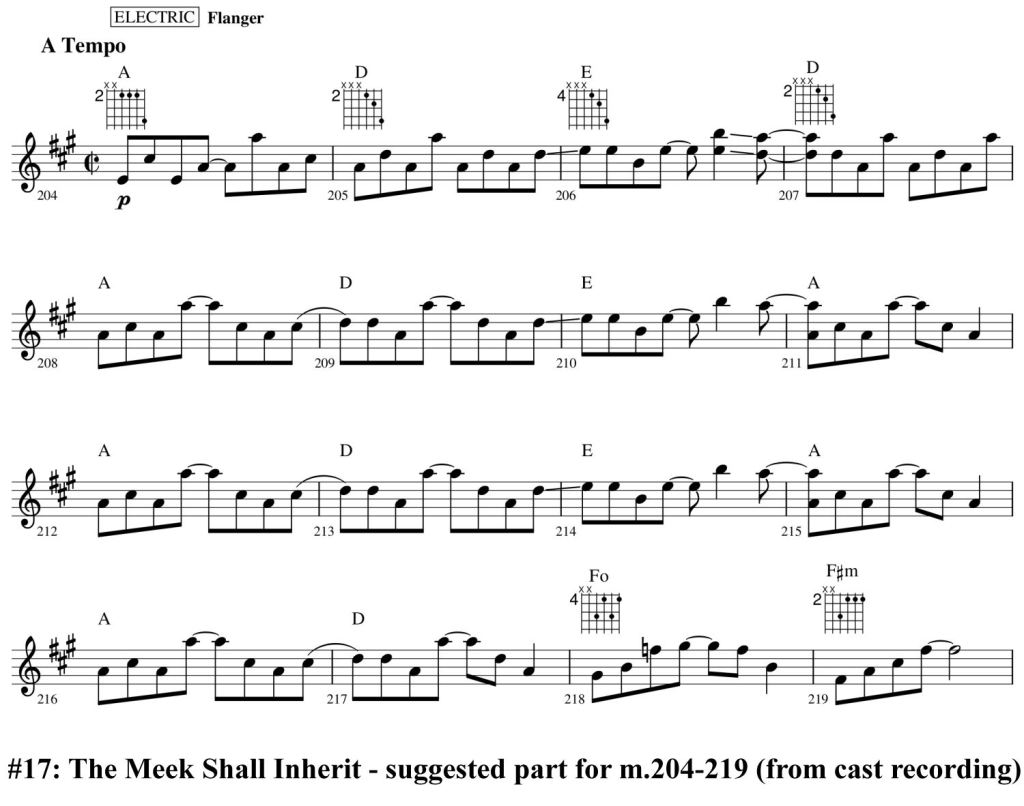
- m.204-219: a variation on the “Meek Shall Inherit” chorus. This is in a ballad style. The Guitar has flowing arpeggios with a Flanger effect (a Chorus would also work here). The part as written is a little basic and robotic sounding. I transcribed something which is much closer to what’s heard on the cast recording, as shown below.
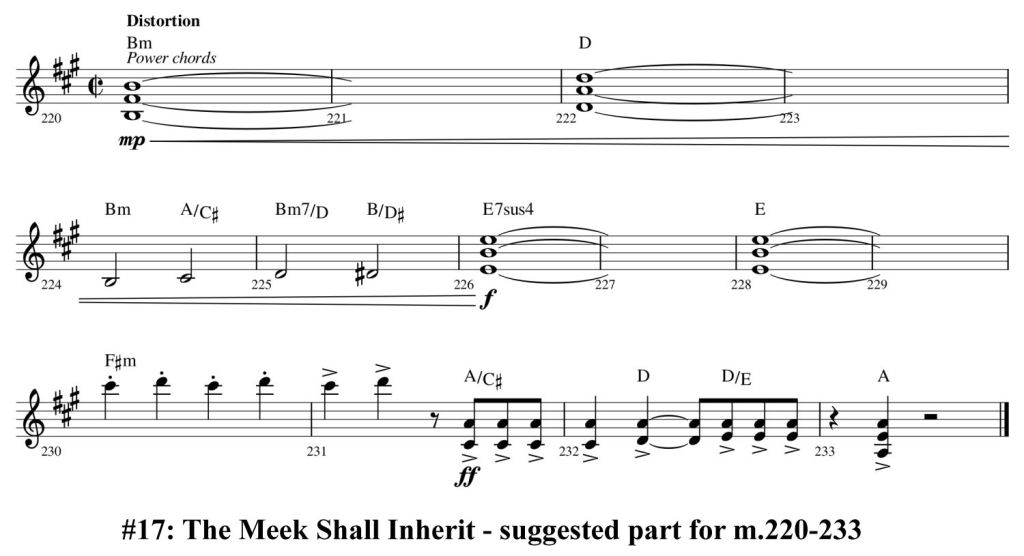
- m.220-233: no change in effects is indicated in the score, but a sudden jump to Overdrive or Distortion should be made at m.220 for the song’s dramatic finish. Once again, the part as written is vague. My transcription is below.
#19A – Suppertime Reprise
Pickup: Pos. 5 – Bridge
Effects: Delay + Reverb (m.19-43), Clean (m.53-73), Distortion (m.75-81)
This is a reprise of #16: Suppertime, and uses the same palm-muted ¼-note delay / reverb effect as that song.
Tips/adjustments:
- m.29-32: play the C an octave higher than written.
- m.53: play a G5 chord, not Gm (see excerpt below).
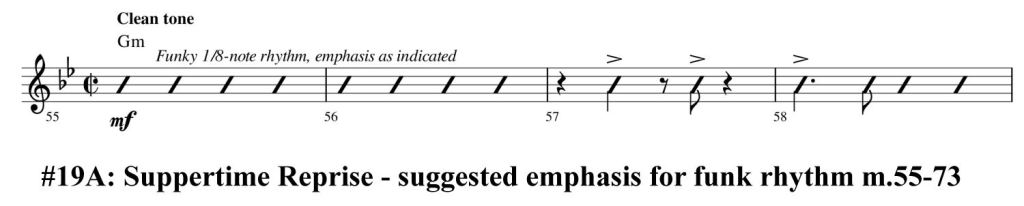
- m.55-73: this is a clean funky rhythm, but don’t be shy. Dig in here. The part is once again vague. Play an eighth-note funk rhythm with emphasis as shown below.
- m.75-81: play power chords with Distortion. At m.81, play just a quiet low G note and fade out.
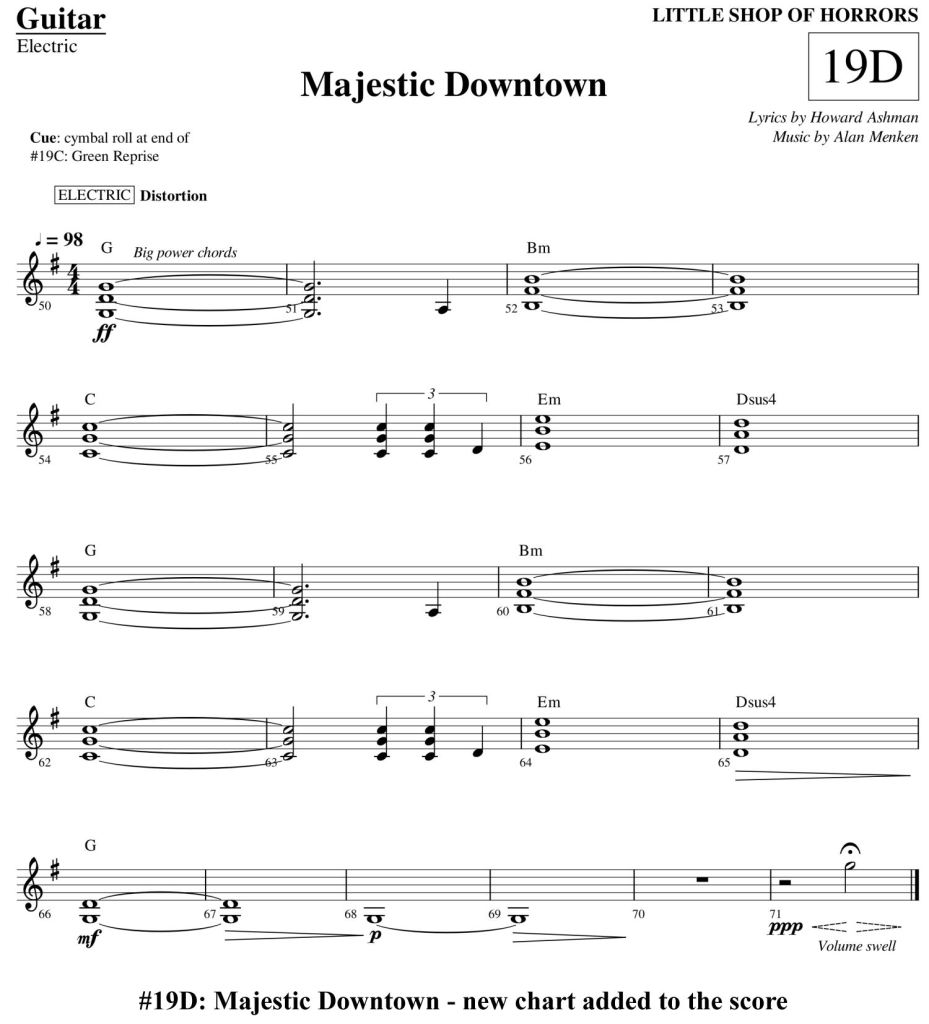
#19D – Majestic Downtown
Pickup: Pos. 5 – Bridge
Effects: Distortion
This is another chart this I added to the score. It’s another short, loud dramatic piece, where Audrey dies, and Seymour feeds her to the plant. The added part is all power chords. Play loud, then gradually reduce the volume from m.65-69. End with a very quiet volume swell in m.71. My chart appears below and can be downloaded here.
#20 – Da-Doo Reprise
Pickup: Pos. 5 – Bridge
Effects: Overdrive (m.5-20), Distortion (m.21-29)
Seymour and Audrey 2 have their final confrontation in this short, dramatic reprise of Skid Row.
Tips/adjustments:
- m.5-10: play short, choppy chords with high voicings.
- m.11-12: play G5 power chords (low voicing, 3rd fret).
- m.13-18: short choppy chords with high voicings again. In m.14 and m.16 play the high C notes as unison bends at the 13th fret.
- m.19-20: low G5 power chord again, starting quietly and building in volume as shown n the score.
- m.21-29: switch to distortion and play the melody part as shown. I replaced the whole note G in m.25 with a repeat of m.24. Play tremolo at m.28.
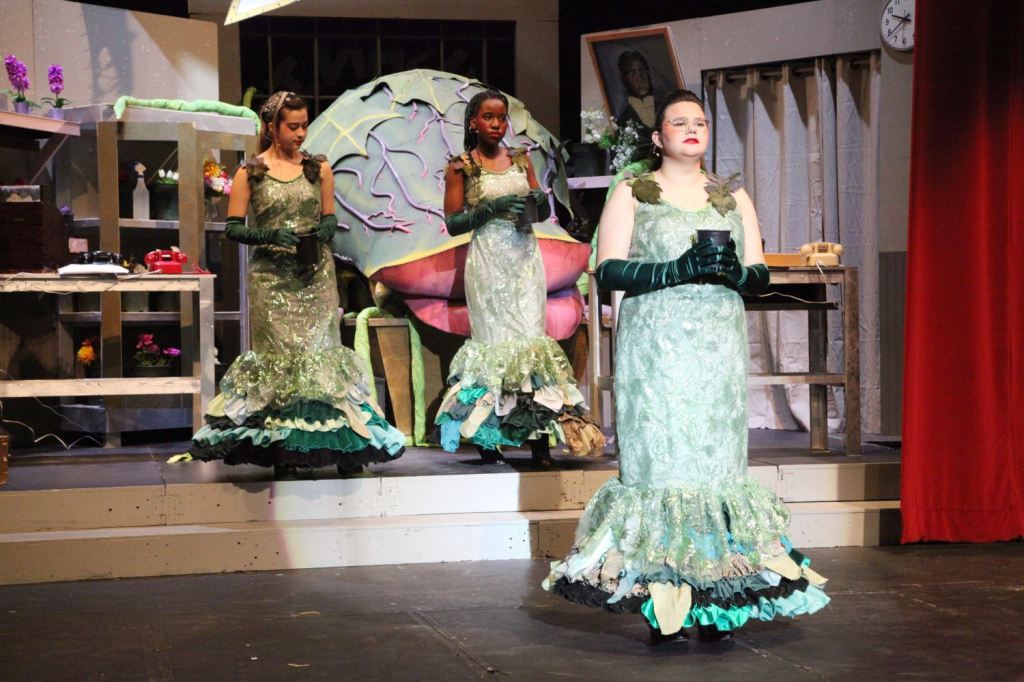
“Subsequent to the events you have just witnessed…”
Image courtesy of Mercer Island High School and ©Alec Chvany
#21 – Finale
Pickup: Pos. 5 – Bridge
Effects: Lead tone (m.36-43), Distortion (m.44-96)
The show concludes with a “what happened next” piece plus a warning (“Don’t Feed The Plants!”). It’s a rocking piece but the chart is not in great shape. I re-transcribed the entire chart, which can be downloaded here.
Tips/adjustments:
- m.36-43: this part should be played an octave higher than written. Use an “epic lead” tone – overdrive or distortion with a long delay. In m.37, 39 and 41, bend the Ab notes up to Bb. All the Bb notes in m.41-43 should be tied together, with added tremolo picking in m.42-43. Accelerate to about 152bpm (the tempo for the rest of the song) through m.42-43.
- m.44-47: the song moves into a faster tempo. This whole section of the chart gives single notes where it should be giving chords. The excerpt below shows what’s provided vs. what you should be playing.
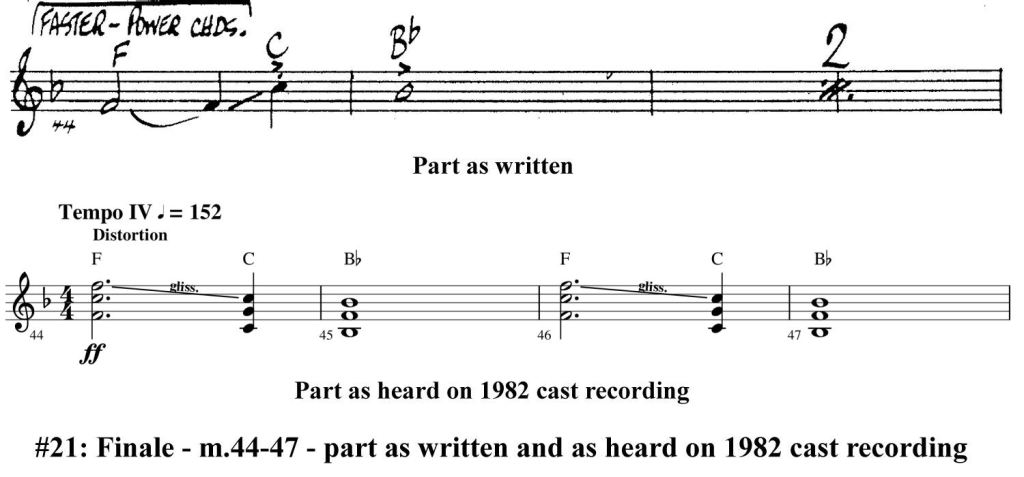
- The rest of the chart continues to be problematic. m.48-53 have notes where there should be chords; m.76, 78 and 80 and completely empty (this is not correct); m.81-84 should be power chords, not single notes; m.89 is empty (it should be and F5 chord). It’s just a completely inadequate chart. Rather than laboriously explain in detail how to play it correctly, I recommend downloading my version of the chart (transcribed from the cast recording), which is a) accurate and b) provides explicit chord voicings for the entire number.
#22: Little Shop Playoff
This is the Bows music for the show, and it’s a faster version of the “Little Shop of Horrors” theme. This number is not included on the 1982 cast recording but can be heard on the YouTube audience recording. I took a tempo of 176 from there.
The existing chart is not really a Guitar chart at all. Confusingly, it squeezes a melody and a rhythm part onto the same stave. The melody is the Keyboard part and the rhythm is derived from the Bass book. I prepared a part that I thought would sit well in the orchestration, while leaving the Keyboard to play the melody line. The Intro and Verse 1 have an overdrive sound that more or less follows the Bass line. Verse 2 and the Bridge switch to rhythm playing with a Clean Chorus tone. At the end of m.32 I switched back to Overdrive for the rest of the number. It’s a simple approach but quite effective. I provide the whole chart here.
#23: Seymour Playoff
This reprise of “Suddenly Seymour” is the show’s Exit Music. This chart is even more vague than the Little Shop Playoff. It combines the melody line from the Keyboard book with a few bass notes (although it’s not really the Bass part, because that book is extremely vague for this number!). A note in the PC score states: “Distribution of melody/solo parts among Guitar, Piano, and Organ at Music Director’s discretion”.
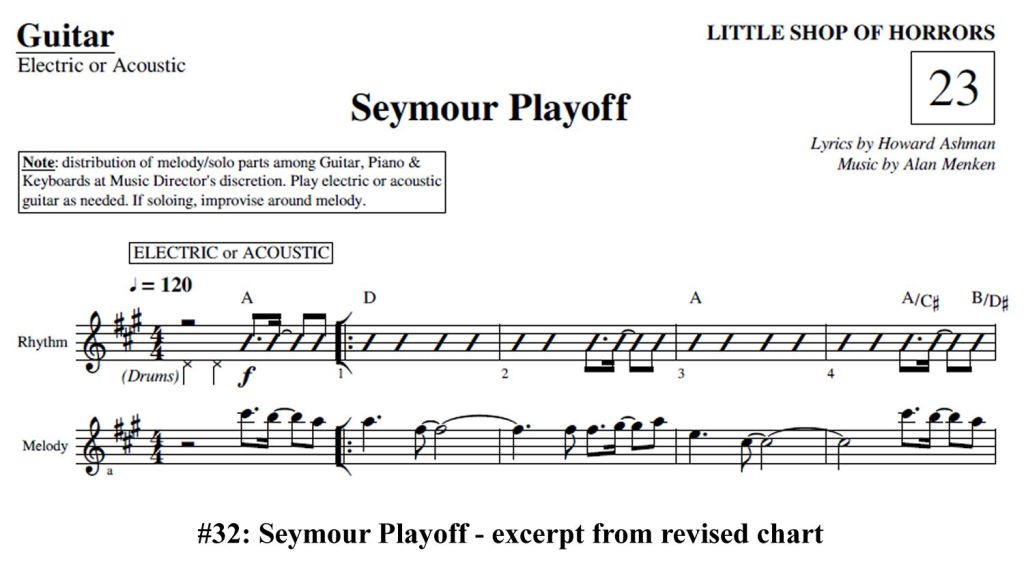
With this in mind I prepared a chart with two staves: “Rhythm” and “Melody” and labeled the chart as being for Electric or Acoustic guitar, depending on the assignment of solos. The Rhythm stave has enough information to keep the Guitar part tight with the Drums, and could be played on either Electric or Acoustic. The Melody stave reproduces more or less the line in the existing chart, but an octave higher so that it would stand out in the arrangement. For tempo I used 120, which is used for the faster section in the YouTube audience recording of #15: Suddenly Seymour. I provide an excerpt below, and the whole chart here.
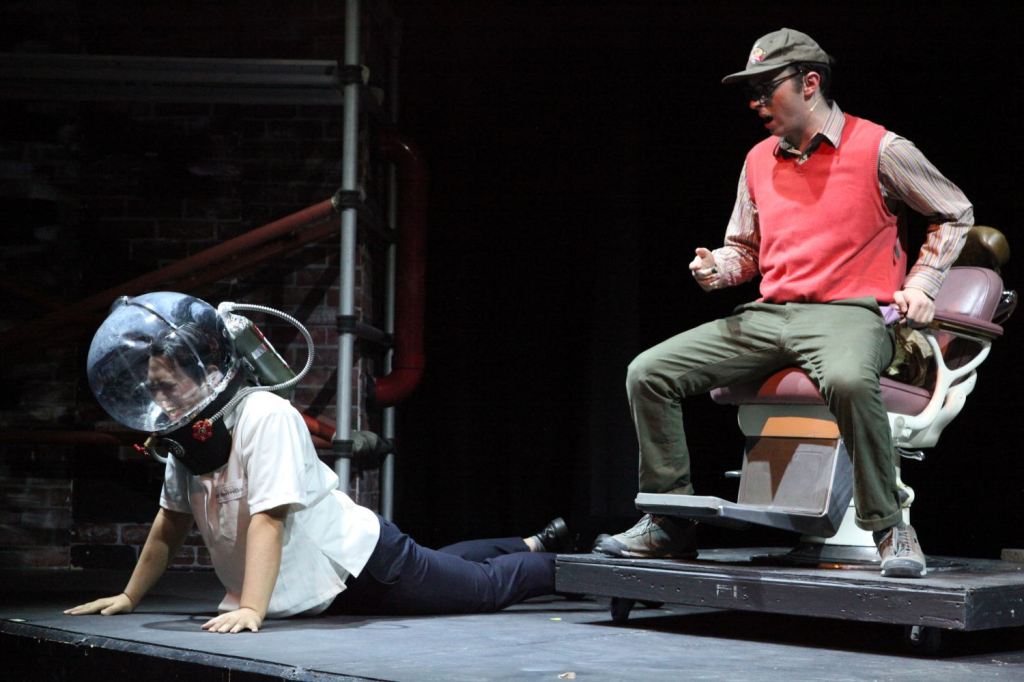
“I’ve laughed myself to…death”
Image courtesy of Mercer Island High School and ©Alec Chvany
LINKS – OTHER ARTICLES AND RESOURCES ON THIS SITE
Playing Little Shop of Horrors – Guitar (companion article, includes discussion of equipment used) – coming soon
List of errors in the Little Shop of Horrors Guitar Book (1982 Off Broadway orchestration)
Tabulated list of tempos for 1982 Off Broadway Production and 1982 Cast Recording
Table of recommended guitar effects settings
Updated Charts (improved transcriptions from 1982 cast recording, except where indicated)
#1: Prologue (new chart added to the score)
#3B: Da-Doo
#4: Grow For Me
#9: Mushnik + Son (new Acoustic Guitar chart)
#12: Dentist’s Chair Intro (new chart added to the score)
#19D: Majestic Downtown (new chart added to the score).
#21: Finale
#22: Little Shop Playoff
#23: Seymour Playoff
LINKS – EXTERNAL
Note: all links were valid at the time this article was published.
Little Shop of Horrors (Musical) Wikipedia page
The Little Shop of Horrors (Original 1960 Roger Corman film)
1982 Off Broadway Production: full video of ACT 1 and ACT 2
1983 West End Production full video
1982 Cast Recording: YouTube Playlist and CD
2003 Broadway Cast Recording YouTube Playlist
2019 Off Broadway Revival Cast Recording YouTube Playlist

 STRUMpit
This is a very timely posting as I have just been booked to play Guitar for a short run of this show at the end of April. I’m sure all of the information you have provided will be invaluable. Thank you.
LikeLike
Hi Kevin, that’s great. Little Shop is so much fun to play (once you make sense of the messy book). Drop me a line if you have any questions and good luck with the show.
LikeLike
Fantastic work on this! I’ve played the 5-piece version twice and the 10 piece twice- the handwritten book for the 5 piece drove me so insane I engraved it on my computer to clean it up and fix a lot of the errors. But as you’ve pointed out- it is not a good chart to begin with. I started to make some personalized adjustments, but your thoughtful changes are a major improvement. I have for YEARS been trying to get to the bottom of “What do they actually want in ‘Call Back…’”? (the nonsense part in the 82 version basically got copied and pasted into the 10-piece). Your new book is making me re-think my personal ban on doing this show any more haha.
I also really appreciate the background research- the inconsistency between the book and the recordings only adds to the frustration. Thanks for sharing your efforts!
LikeLike
Brad, thanks for the comment. I appreciate the kudos! Once I had the new book to work from I really enjoyed playing the show. Didn’t feel like I was fighting the charts anymore. If you end up signing up to play the 5-piece again send me a message through the Contact page.
LikeLike
Thank you so much for this. It’s been such a massive help. I’m in the pit band for Prestwich at The Met in Bury all next week and I’m so glad I found this blog.
LikeLike
Really pleased to hear you found the blog useful. I’ll be publishing an equipment rundown for LSOH before too long – has taken a while as I’m swamped with shows this year. Good luck with your production and let me know if you have any additional questions about the score.
LikeLike
Hello! This article looks amazing and is super helpful as I’m about to play this show for the first time. Is there a link to the your entire updated score I’m not seeing? I see that certain numbers have the link to download the chart, but not all of them do. If there is a way I could get the whole edited part that would he super awesome.
thanks!
LikeLike
Hi Daniel, can you send me a message through the blog’s “Contact” page?
LikeLike