Twelfth Night – Detailed Notes on the Guitar Book
Conceived By: Kwame Kwei-Armah & Shaina Taub
Music & Lyrics: Shaina Taub
Year: 2016 & 2018 (The Public Theater, New York)
In late 2020, during the Covid-induced shutdown of Seattle’s theatres I was deliriously happy to contribute to a streamed production of excerpts from Shaina Taub’s lovely musical adaptation of Twelfth Night. Now, nearly three years later I have had a chance to play a month-long run of a fully-staged production of the show, complete with an on-stage band featuring some old friends and a top notch cast. Ironically we lost over a week of the run due to an outbreak of Covid in the cast, but still it has been a most fulfilling experience. I’m grateful to the Seattle Shakespeare Company for the opportunity, and also to Music Director R.J. Tancioco, who hired me (again!) for this show. R.J. always challenges my musical limitations and I emerge from each project with him feeling like a slightly better musician and performer.
In this article I take a brief look at the orchestration for the show and provide a rundown of the equipment I used to play it. After some general comments on the score I then take a detailed dive into the Guitar book, describing my approach to playing it, identifying the errors I found (there are quite a few) and adding detail in areas where the book is vague.
Program for Twelfth Night, Seattle Shakespeare Company, 2023
ORCHESTRATION
The show’s music is mostly a pop/soul/funk mix, with a bit of theatrical vaudeville thrown in for the more comical moments. The pit ensemble comprises a pop band with brass: Bass, Drums, Guitar, two Keyboards, Trumpet, Tenor Sax and Trombone. Orchestrator Mike Brun was clearly aiming for the ensemble to sound more like a band than a formal pit orchestra. For this reason, the orchestrations are written with a deliberate degree of vagueness. His introductory notes in the books state that “the orchestrations call for a lot of ad-libbing in the charts, to personalize the sound. This is particularly true in the rhythm section”. Put simply, grooves are more important than precision and consistency in this show (a rare thing in musical theatre!). As a guitarist, it’s good to keep this in mind as you rehearse and focus on locking in tightly with the rhythm section.
With such a small ensemble, options for reduced orchestration are limited. The only real options you have are to omit Keyboard 2 and Trombone. Even then some of the trombone cues have to be picked up by Keyboard 1 and the other horn players. Removing Keys 2 made sense in the small theatre we were playing in, where six musicians already made for a full sound. Again, some parts were picked up by the Keys 1 player, and the keyboard solo in #13: What Kind of Man R U Gonna Be, became a Guitar solo. You could reduce the brass section further by having Keyboard 2 cover brass parts, but that wouldn’t sound great and I don’t recommend it.
EQUIPMENT USED
Instruments
The Guitar book calls for Electric Guitar and Ukulele; the book is mostly Electric Guitar. For our production we added Tenor Banjo, for the reasons described below.
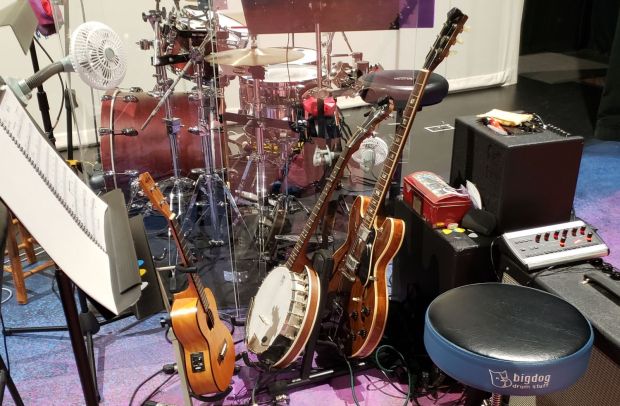
Instruments for Twelfth Night: Gibson ES 335 TD electric guitar, tenor banjo & tenor ukulele
Electric Guitar: the jazz and funk score suits the warm sound of a Gibson-style electric with humbucker pickups. I used a walnut brown 1974 ES 335 TD, and for most songs used both neck and bridge pickups, switching occasionally to just the bridge. I think that for this score other types of guitar would also work (particularly a Strat), depending on your preferences and those of the Music Director.
Ukulele: I used a Kala tenor ukulele, with a built in pickup, and strung with a low G-string rather than the high G used in the standard re-entrant tuning. Mike Brun, the orchestrator states in the book’s introductory notes that the ukulele in the original production was “a custom instrument that was tuned lower and differently than a standard tenor ukulele”. I tuned the instrument Gb-B-Eb-Ab, a semitone lower than normal (I had previously corresponded with Mike Brun on this subject in respect of “As You Like It”, and suspect that the same tuning was used for “Twelfth Night”). This tuning results in straightforward, practical fingerings for the ukulele numbers in the show.
Tenor Banjo: although the book doesn’t call for it, we swapped ukulele for tenor banjo (a Deering Boston which I bought in 2022 and have been very pleased with) for all of Malvolio’s numbers except for #15: Greatness. Malvolio is the most ridiculous figure in the show (there is plenty of competition for the title) and using a tenor banjo had the effect of adding a vaudeville feel to his numbers and simultaneously giving him a distinctive musical voice in the show. I recommend it! I used a Myers Feather Pickup for the banjo, running through an Empress Para EQ for tone shaping. I also stuffed a cloth between the banjo head and arm rest, to reduce the resonance (boominess?) of the banjo sound.
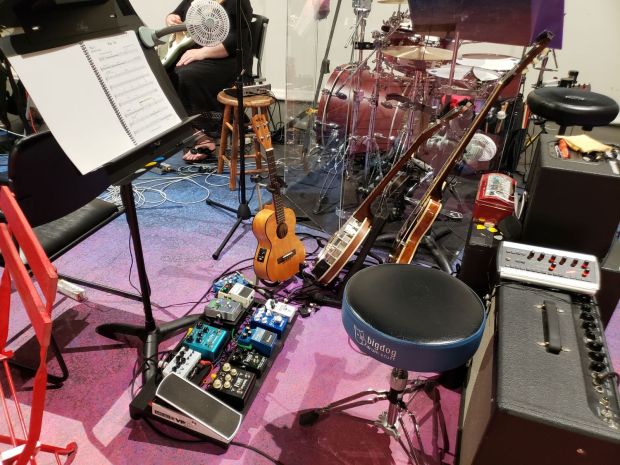
Guitar setup for Twelfth Night, Seattle Shakespeare Company, 2023
Amplification:
The band was on stage in a small theatre, which meant volume management was important. No speaker cabinets were used; all electric instruments were input directly to the mix. Drums were sonically isolated using a plexiglass enclosure. Observant readers may notice the Fender amplifier at the back of my setup in the photo above. This was used only for early rehearsals before everything was patched into the house mix. From tech rehearsals onwards it wasn’t even switched on. I used the following amplification:
- Electric Guitar: I used a DSM & Humboldt Simplifier Mk1. This ingenious unit (which the manufacturers describe as a ‘zero-watt amplifier’ is the size of a standard effects pedal but contains just about everything an amp should have (gain, tone, presence, speaker cab simulation, stereo effects loop). It includes both standard, XLR and headphone outputs, in stereo. It’s also a fully analog unit. The new Mk2 version also includes a reverb.
- Acoustic instruments: I ran the ukulele and banjo through a Boss LS-2 line selector into my trusty AER Compact 60 acoustic instrument amplifier. Although the amplifier was muted on stage, I used it to set gain, overall tone and a hint of reverb. It has an XLR output which was connected to the house mix.
Monitoring
Since there were no speakers on stage, monitoring was via headphones and in-ear monitors. Each member of the band had a Behringer PowerPlay P16-M personal mixer so we could set our own mix for the show. I used Etymotic Research ER4SR in-ear monitors.
Effects:
I increasingly find it necessary to use a programmable multi-effects unit (usually a Line 6 Helix) to meet the multifarious needs of modern Broadway scores, so it was refreshing to be able to use a simple stomp-box based board for this show. Unusually and very helpfully, the “Orchestrator’s Notes” included in the score describe the effects pedals required, the order they should be placed in and the specific models used in the original production. Unfortunately the notes omit one important pedal: the Envelope Filter. I contacted the Orchestrator, Mike Brun, who was able to provide the missing details. Here then is a picture of my pedal board, followed by notes on the effects I used for the show and details of the signal chains for the various instruments.

Pedalboard for Twelfth Night, Seattle Shakespeare Company, 2023
- Envelope Filter: used for funky wah rhythm parts and solos in the various “Word On The Street” numbers. I used a Keeley Neutrino. The original production used a 3Leaf Audio Proton. These are hand made in batches of 100 by one person in Seattle and hard to get hold of – batches go on sale periodically and sell out in 60 seconds. I’ve signed up to be notified when they are available again!
- Compressor: I had a Wampler Ego on the board just in case I needed it to help manage variations in output level of the Envelope Filter, but in the end I didn’t use this pedal.
- Overdrive: used for distortion and boost. The book calls for a Boss Blues Driver with a Keeley modification. Boss now makes its own version of the Blues Driver incorporating this modification: the BD-2W Waza Craft Blues Driver. This was the version I used.
- EQ: this is not called for in the score. I used a Source Audio Programmable EQ. This graphic EQ allows you to store and use multiple EQ profiles. It’s MIDI addressable but in this case I adjusted it manually for the one time I needed to change settings. For most of the show I had it set just to act as a high pass filter for basic tone shaping. In #13: What Kind Of Man RU Gonna Be, I was asked to take a solo and used a second EQ profile to make the solo pop out of the mix, with a very slight volume boost as well.
- Volume: used for volume swells, which feature very prominently in the Guitar parts. as usual I used an Ernie Ball VP Jr. volume pedal.
- Delay: used for slapback delay. I used an MXR Carbon Copy, as per the book.
- Tremolo/Wet Reverb: the book calls for a Strymon Flint, which incorporates both of these effects, aiming to simulate the tremolo and reverb you would get from a vintage tube amp. I bought the pedal especially for Twelfth Night and it’s incredibly good. (it’s my new favorite pedal!). The reverb is meant to be a rich, wet reverb. I recommend listening to the cast recording to get an idea of the required settings.
- Room Reverb: I also used a Strymon Blue Sky for an “always on” room reverb, not really an effect, more of an ambience, and very subtle. This is not called for in the score.
Signal Chains
The signal chains were as follows:
Electric Guitar → Envelope filter (Keeley Neutrino) → Compressor (not used) → Overdrive (Boss BD-2W Blues Driver) → EQ (Source Programmable EQ) → Volume pedal (Ernie Ball VP Jr.) → Simplifier input → Simplifier FX Send → Delay → Tremolo + Reverb (Strymon Flint) → Room Reverb (Strymon Blue Sky) → Simplifier FX Return → Simplifier XLR output → house mixing desk.
Ukulele / Tenor Banjo → Boss LS-2 Line Selector → AER Compact 60 Amplifier input → AER Compact 60 XLR output → house mixing desk.
Accessories:
I used the following additional gear:
- Herdim picks (various sizes)
- My good old Big Dog drum stool (sadly discontinued)
- Shubb capo for the Tenor Banjo
- Standard Manhasset 4801 music stand with handy shelf attachment
- Aria Forte rechargeable LED stand light
- An On-Stage A-frame double guitar stand (model GS7462DB) for the guitar and tenor banjo
- Ingles SA20 violin stand for the ukulele
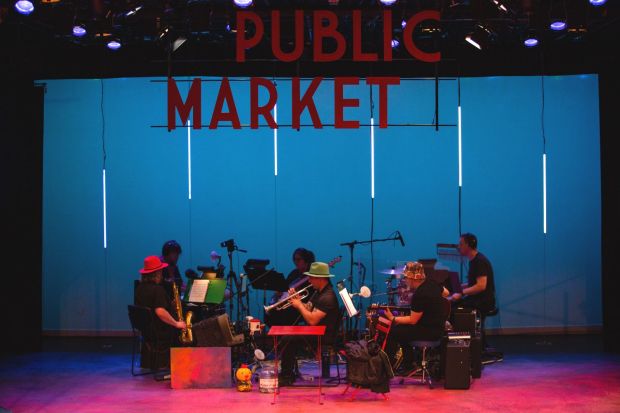
The Twelfth Night Band (On Stage!). Image courtesy of Seattle Shakespeare Company & © John Ulman Photography
GENERAL NOTES ON THE GUITAR BOOK
As noted above in my comments on Orchestration, the Guitar book is written with a deliberate degree of vagueness. This means that the charts have a lot of slash marks and give you a lot of latitude in interpreting the music. However, in some places I found the lack of detail a little frustrating (for example in #5: If You Were My Beloved (Reprise). This pretty guitar solo could really do with a detailed chart (I provide one below).
Errors: there are quite a lot of errors in the book, to the extent that I have prepared a separate listing (download here) as well as listing the errors in my detailed notes on each number below.
Page turns in the book are all good, although a few are pretty quick. There is one exception: the turn from p45 to p46 at m.54 of #23: Eyes Of Another. There’s really no good place to put this page turn so I added a fold-out third page to avoid it altogether.
Overall, this is a fun book to play; it’s sophisticated enough to be interesting to play every night for several weeks, but not excessively difficult either.
SONG-BY-SONG DETAILED REVIEW
The following notes cover every number in the book except those where the Guitar is tacet. As noted above, the book is deliberately vague in places, in order to give the band some freedom to interpret the material. I explain my approaches and choices, but this is not intended to be an “instruction manual”; rather, I hope it will provide insights and ideas to guitarists preparing to play the show, and bring clarity where the vagueness of the book is less than helpful. The notes will only make sense if you have a copy of the book to refer to.
Pickup settings: I include the pickup settings I used for each song. Since I used a Gibson ES 335, the choices are Neck, Neck + Bridge or Bridge. I actually used Neck + Bridge for almost the whole show, switching to Bridge for only four numbers.
Effects Settings: I provide details of all of the effects I used for each number. Mostly I followed the direction given in the book, but I did depart from it in a few places. In addition to the effects noted, I had my subtle “room” reverb on throughout.
#1: Play On
The show opens with a funeral procession, set to a New Orleans style dirge, before switching to a lively swinging Mardi Gras feel. This is a scene-setting number, setting out various plot threads, so there are a few changes of feel and several effects changes, ultimately returning to the Mardi Gras feel at the end.
Pickup: Neck + Bridge
Effects: m.30-46: none / m.53-54: delay, reverb / m.56-72: delay, reverb, overdrive / m.74-98: none / m.99-112: reverb / m.121-123: reverb, overdrive / m.141-180: none.
Tips/adjustments:
- m.30-46: the book provides slash marks and chord symbols. I found it better to keep the rhythm relatively simple and uncluttered, to best support the groove of the drums and bass. For m.30-35 beat 4 of each measure should be Eb/Bb, not Bb as shown. The excerpt below shows this section as written and as I played it.
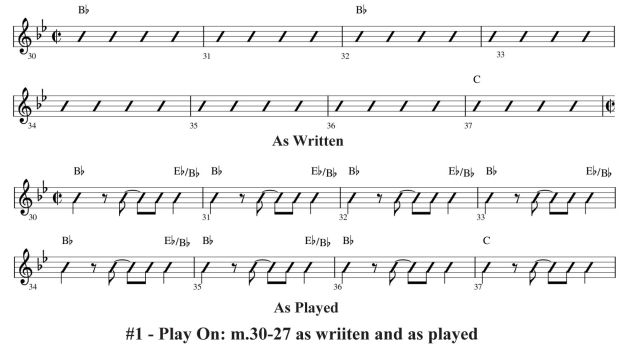
- m.53-54: the first of innumerable volume swells in the book. The book says to use delay, reverb and overdrive. I omitted the overdrive as this is a quiet moment. Play the swell the first time only, not on the repeat.
- m.56-72: add the overdrive for this section. More volume swells on every note. After m.72, quickly turn all three effects off before hitting the D7(#9) chord at m.74. There is an error in m.68: it should be a B-natural.
- m.83-92: the score calls for “chunking” on 1/8-notes, but this is cut time so it should be on 1/4-notes. I played this as shown in the excerpt below. Reverb on quickly at the end of m.98.
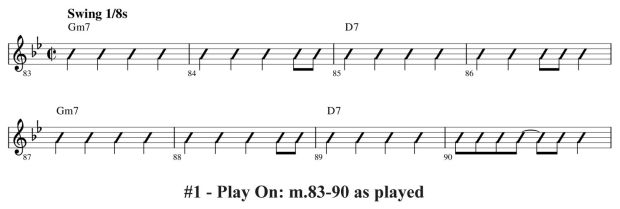
- m.103-108: I played palm-muted descending arpeggios with low voicings, as shown in the excerpt below.

- m.121-123: I added overdrive to the reverb for these volume swells. All effects off after m.123.
- m.149-164: the score calls for “a more modernized second line”, which I took to mean a funkier rhythm, but again I found that keeping the rhythm simple made for a punchier rhythm section. I played it as shown in the excerpt below.

#1a: “Play On” Play-Off
A brief reprise for a scene change. The Guitar has the lead line, but measures 2 and 6 do not match the Piano Vocal score. I modified these measures to match, as shown below. My chart can be downloaded here.
Pickup: Neck + Bridge
Effects: overdrive throughout.
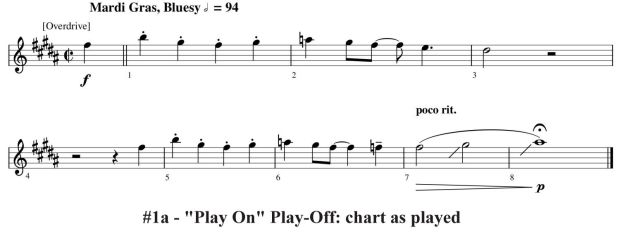
#1b: Let Us See The Caper
This is a brief dance intro to #2: Word On The Street. Guitar plays a muted “dead note” 1/16-note rhythm throughout.
Pickup: Neck + Bridge
Effects: envelope filter throughout.
Tips/adjustments:
- Volume: envelope filter wah is a very noticeable effect to the point that it can be distracting. Ride the volume pedal so that you sit comfortably in the rhythm section without dominating the sound. Listen to the drums and feel the groove.
- The chart indicates an Applause Segue into #2, but it’s more likely to be a segue. I suggest memorizing this number (not hard!) and having the page for the next chart ready to avoid a tricky page turn, because it’s very important to hit the downbeat of #2 correctly.
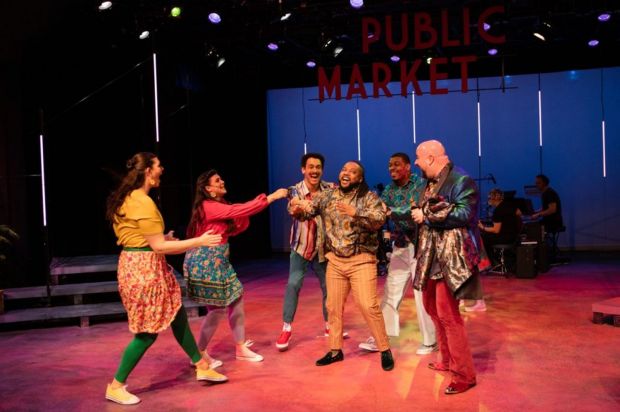
“Let Us See The Caper!” Image courtesy of Seattle Shakespeare Company & © John Ulman Photography
#2: Word On The Street
A funky ensemble number, which appears a further three times during the show. Just play funky rhythm, focus on the drums to get your groove to sit nicely in the rhythm. Again, pay attention to your volume so that the wah effect doesn’t become distracting.
Pickup: Neck + Bridge
Effects: envelope filter throughout.
Tips/adjustments:
- m.22: the chord name is incorrect. This should be A7(#9), not Ab13(#9).
- m.26: cut off crisply and abruptly at the end, as indicated.
#3: Tell Her
I used the Bridge pickup to get a brighter sound for this number, which is a kind of 60’s bop. Like so much of the book, this is all about getting the right feel for the song.
Pickup: Bridge
Effects: m.1-16: none / m.27-39: reverb / m.47-69: none.
Tips/adjustments:
- There’s only a few seconds of down time between this number and the previous one. Make your effects and pickup changes quickly and be ready to go.
- m.1-16: Guitar and Bass play in unison throughout this section, one of several places in the score where this approach is used. Listen to the Bass, play crisply and keep it neat.
- m.27-39: add reverb for this section. I used volume swells on every note, as suggested in the book. Reverb off after m.39.
- m.47-52: I played chord voicings on the top four strings, at the 4th and 6th frets.
- m.69: I played an Eb-Ab-Db-F voicing for the Db/Eb chord, at the 6th fret. Gradually fade the chord out through m.70 using the volume pedal.
#4: If You Were My Beloved
A beautiful soulful ballad, one of several musical highlights in the show. The chart references Amy Winehouse’s “Love Is A Losing Game” as a touchpoint for the feel, and this is a good place to start.
Pickup: Neck + Bridge
Effects: m.13-35: reverb / m.36-60: none.
Tips/adjustments:
- m.13-22: I played low to mid-range voicings, mainly on the top four strings. You don’t need to be too percussive – there’s a softness to this song. Cut off cleanly for the rest on beat 4 of m.18.
- m.26: I played a C#-G#-B-D# voicing for the G#m/C# chord and rolled it ever-so-slightly. Watch the conductor for this cue so you hit it in sync with the keyboards. Hold the chord through the brief ensuing dialogue.
- m.28-35: similar voicings to the first verse, but with a little more rhythm. Cut off cleanly for the rest on beat 4 of m.33. Reverb off at the end of m.35.
- m.36-37: the vamp should be quiet – this is underscore.
- m.38-39: the lick from m.38 into m.39 should be played at the 11th fret.
- m.40-45: once again Guitar is in unison with the Bass. Listen to each other and keep it tight.
- m.53: there is an error in the score. Beat 4 should be a rest.
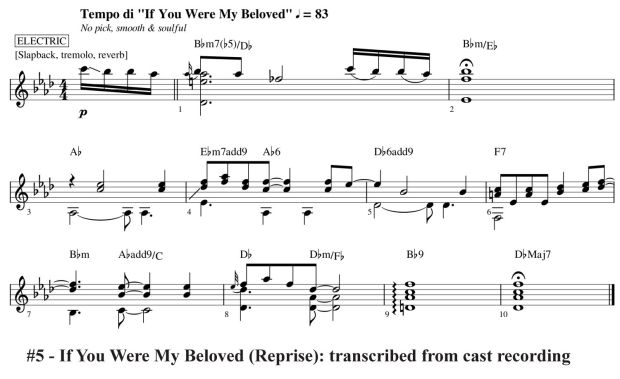
#5: If You Were My Beloved (Reprise)
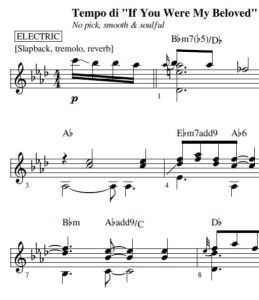
This short reprise is a big and exposed moment for the Guitar; it’s just guitar and solo vocal throughout. The chart is not very helpful, providing only a melody line for the first two measures followed by basic chord names, slash marks and the comments “jazz extensions welcome” and “What would Blake Mills do?”. Well, he might ask for a better chart, frankly. The version on the cast recording is very pretty and does indeed feature plenty of jazz extensions. I transcribed and played it as shown below. You can download my chart here. The melody line in the first two measures is a little tricky to get right consistently.
Pickup: Neck + Bridge
Effects: slapback delay, tremolo & reverb throughout
#6: Voila’s Soliloquy
This is another pop/rock number, where Viola ruminates on the relationship entanglements developing between the main characters, and on how differently she is treated when dressing as a man instead of a woman. The number goes through several feel changes. I made some changes to the recommended effects settings for this number. In particular I ignored the direction at the top to use “a searing rock sound” and “Overdrive with plenty of sustain”. To me this number seemed to suit mostly a cleaner sound. The cast recording does use Overdrive in places.
Pickup: Bridge
Effects: m.4-12: delay / m.39-52: delay, reverb / m.53-97: delay / m.99-103: delay, reverb, overdrive / m.123-128: delay, reverb / m.131-134: delay, overdrive / m.152-153: delay.
Tips/adjustments:
- Effects generally: there’s a fair bit of tap dancing between reverb and overdrive in this number. Take some time to get used to the sequence of pedal changes. Slapback delay stays on throughout the song.
- m.4-12: all of these measures should be palm-muted.
- m.12: error – there should be a rallentando at m.12.
- m.39-51: play as written. There should be volume swells on every note.
- m.97: this seems like an error. I think there should be chords rather than single notes on this measure (and that is what is heard on the cast recording).
- m.123-128: I played voicings at the 9th and 11th frets.
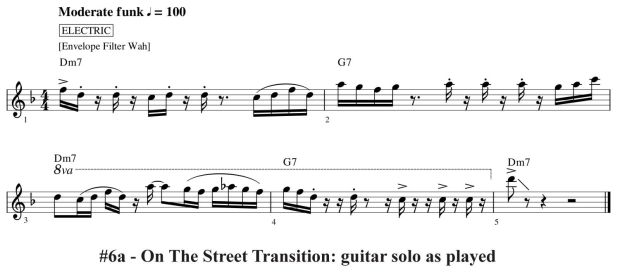
#6a: On The Street Transition
A brief scene change number and the second appearance of the “Word On The Street” theme. The chart provides only chord names and slash marks but you may be asked to play a guitar solo. I provide a chart showing roughly what I played below (downloadable version here). There is an error in m.5 of the chart: it is missing a Dm7 button with a glissando on beat 1.
Pickup: Neck + Bridge
Effects: envelope filter throughout.
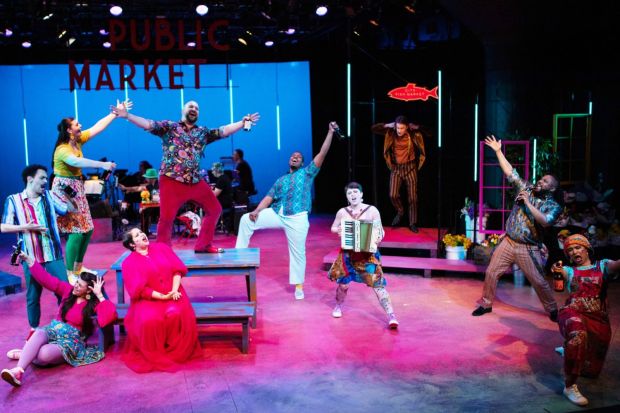
“You’re The Worst”. Image courtesy of Seattle Shakespeare Company & © John Ulman Photography
#7: You’re The Worst
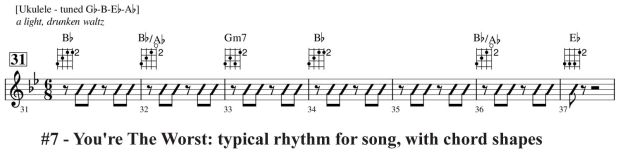
The tempo marking describes this number as a “Drunken Oom-Pa” and that’s a pretty good description. It’s basically a drinking song and this scene is one of the comic highlights of the show. The Guitar book calls for ukulele for this number; as noted above I used a Tenor Ukulele tuned Gb-B-Eb-Ab, with a low Gb string (I am pretty sure this is what the original guitarist used). This tuning results in straightforward chord fingerings.
Instrument: ukulele
Tips/adjustments:
- The score is all slash marks, not even providing a basic rhythm to get you going. The excerpt below is how I played it (the same as the cast recording). I include chord diagrams for the tuning I used for reference. The song continues with the same rhythm throughout.
- m.37: the music stops on the downbeat to emphasize the vocal. There are similar stops in several places throughout the score. I mention this only because it’s easy to miss these measures in the sea of slash marks!
- m.55: error. The second half of the measure should be a rest.
- m.82: error. There should be a caesura at the end of the measure. m.83 is a pause for dialogue.
- m.103: error. The second half of the measure should be a D7 chord, not Eb.
- m.104-110: suggestion. For a big finish to the song I played a busier rhythm for this section (example below).
- m.111: error. The slash marks are incorrect. A specific rhythm is required for this measure. Play Bb chords on beats 1 and 5 with beat 5 accented, as shown below.

#7: You’re The Worst Tag
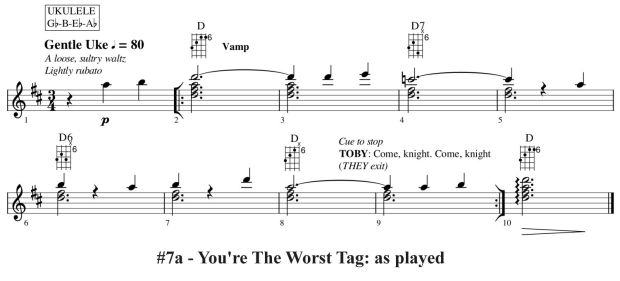
Instrument: ukulele
This is a short scene transition piece. The drunken revels are over and everyone is heading off to sleep. So it’s a loose, quiet ukulele solo – melody over strummed chords. The chart provides the melody line but not the chords. I provide a detailed chart below, which can be downloaded here. You play the melody on the two high strings while gently strumming a chord on the downbeat of each measure.
#8: Is This Not Love
A powerful, soulful ballad – another musical highlight of the show. The chart for this number is purposefully vague, giving you latitude to do what works for the band you’re playing in. As you can see from the listing below there’s a fair amount of pedal tap dancing to do. I made a few departures from the settings on the chart. I haven’t included any excerpts to clarify my approach to this number, as the chart itself is sufficient. It’s really all about establishing the feel of the number.
Pickup: Neck + Bridge
Effects: m.1-39: delay, reverb, tremolo / m.41-54: delay, reverb / m.56-59: delay, reverb, overdrive / m.63-77: delay, reverb / m.79-92: delay / m.93-101: delay, reverb / m.111-115: delay, reverb, tremolo / m.117-148: delay / m.150-153: delay, reverb, overdrive.
Tips/adjustments:
- The key to this song is to build the emotion gradually throughout the number. For the Guitar that means you start playing ambient textures (the ubiquitous volume swells again, plus effects) and progress towards fewer effects and more strummed rhythm. Doubtless your Music Director will have thoughts on how the band sound should build through the number.
- m.1-24: play volume swells as shown. I used low voicings, mostly avoiding the high E string. Think ambient textures.
- m.33-39: I started introducing arpeggios in this section (“motion/lines” as indicated).
- m.41-54: the first chorus. I played mostly gentle chords with occasional passing notes. No particular rhythm, just texture but more present that in the preceding verse. Fast page turn at m.54.
- m.45-59: this is a little melodic solo for the guitar. I used volume swells as indicated and overdrive to boost the volume. I didn’t use a slide.
- m.63-77: 2nd verse. Back to ambient texture. The score says “creating a soundscape”. I used a combination of gentle chords, volume swells and wisps of melody – as if the part was blowing in on a breeze, just about perceptible but you’d notice if it wasn’t there.
- m.79-92: 2nd chorus. I turned all effects off except the slapback delay and strummed a rhythm for the first time in the song – but nothing too busy.
- m.93-101: this is underscore for dialogue. I added reverb (but not tremolo) and went back to the approach I used for the 2nd verse: volume swells and hints of melody.
- m.111-115: volume swells building towards a big bridge section. The score says to add tremolo but I didn’t. Too much pedal tap dancing and it didn’t seem necessary. Fast page turn while you also turn off the reverb.
- m.117-132: a big, intense bridge section. Reverb off, and I strummed chords – the most rhythmic yet (just keep building the song). Arpeggios from m.129-132, building towards the final chorus.
- m.133-148: the final chorus. Play big, loud and more rhythmically. The score says to add reverb again, but that didn’t seem appropriate.
- m.150-153: reverb and overdrive on for another little mini-guitar solo, with volume swells.
“Count Malvolio”. Image courtesy of Seattle Shakespeare Company & © John Ulman Photography
#9a: Count Malvolio Part 2
Instrument: ukulele (or tenor banjo with capo)
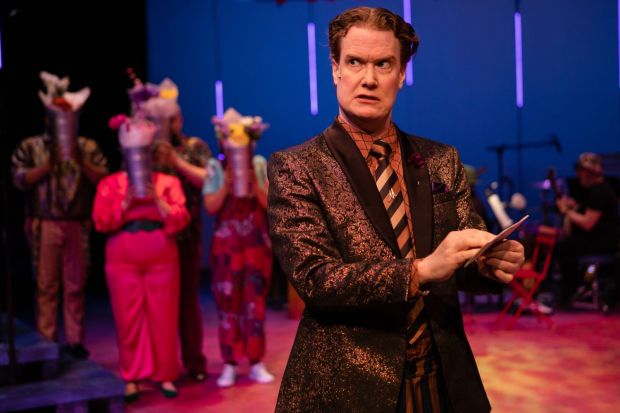
This is another big comic moment in the show. Malvolio indulges his delusions of grandeur, egged on by Sir Toby and his mischievous friends. It’s a number in two parts with a speech between them, and the whole thing has a vaudevillian feel. Guitar comes in starting at the dance break in Part 2. As noted above, I used Tenor Banjo instead of Ukulele for most of the show’s “Malvolio” numbers and it worked very well indeed. If you have one available I strongly recommend it. I used Chicago tuning (like top 4 strings of a guitar) and a capo at the 4th fret for this number to maintain the same voicings I had established for the ukulele, but this isn’t really necessary. Use whatever voicings work for you – playing this number is all about the rhythmic feel.
Tips/adjustments:
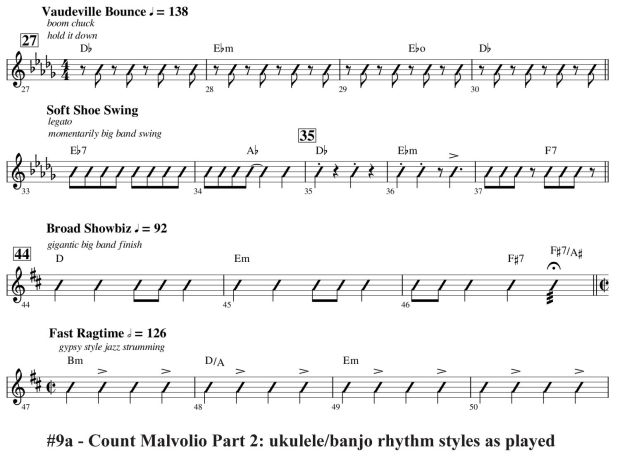
- This number is mostly straightforward strumming. The rhythm has four distinct feels: “boom chuck” for m.27-30 and m.38-41, a big band swing for m.33-37, a broad big band feel for m.44-46 and a fast gypsy style strum for m.47-64. The chart is mostly slash marks so I provide some excerpts showing the rhythms I used below.
#9b: Count Malvolio Play-Off
A brief play-off for Malvolio. This is just straightforward boom-chuck rhythm. Again, I used Tenor Banjo with capo at 4th fret.
Instrument: ukulele (or tenor banjo with capo)
#10: I Am She
This is a kind of smooth shuffle number, with a hint of reggae thrown in. It’s very 70s and feels like the smoothest vanilla latté you ever drank.
Pickup: Neck + Bridge
Effects: none.
Tips/adjustments:
- I used mostly low voicings for this number. Pay special attention to the rhythm markings: there are a lot of off-beat chord changes and you need to hit them all to keep the band tight. Pay attention also to rests and articulate cleanly to emphasize them – the whole band typically has the same rests.
- m.31-32: I played higher 8th fret voicings for the Cm7 and Ab chords (this is what I heard on the recording).
- m.47-48: I ignored the direction in the score to add reverb and slapback delay for these two measures. It seemed like pointless tap dancing and didn’t add anything to the song.
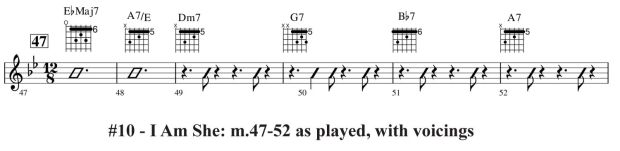
- m.49-52: error – these measures are missing chord symbols. They should be as shown below (I include the chord voicings I used). I also departed from the rhythm shown to give it a more reggae feel.
- m.63-68: inexplicably the guitar is Tacet for the end of the song. This makes no sense. I added in the part as shown below.

#11: Word On The Street II
The third appearance of the “Word On The Street” theme and its fullest expression.
Pickup: Neck + Bridge
Effects: m.1-11: envelope filter / m.12-18: none / m.19-23: envelope filter / m.25-29: none / m.30-32: envelope filter.
Tips/adjustments:
- m.2-9: play the solo exactly as written. Guitar plays in unison with Bass (again) here, so it’s important to keep the two instruments tight. It’s worth practicing together a few times.
- m.12-19: no effects. Play an 1/8-note rhythm with occasional 1/16-note embellishments. At m.19 turn on the envelope filter and play a funky Beyonce-influenced rhythm (think “Crazy In Love”).
- m.30-32: once again, play the solo exactly as written in unison with the Bass. I transposed this up an octave.
#12: Count Malvolio (Reprise)
Instrument: tenor banjo, no capo
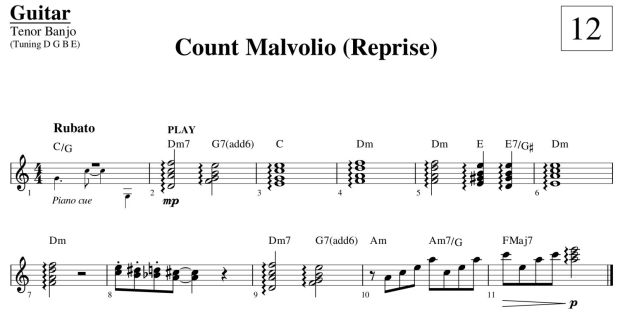
The score has this as a keyboard solo (Guitar and everyone else Tacet), but it was crying out for another banjo part, this time with no capo. I provide the chart I wrote for this below; it can be downloaded here. This worked very nicely and is in keeping with the idea of the banjo emphasizing Malvolio as a comic figure.
#13: What King Of Man R U Gonna Be?
This is an odd number. It’s has a kind of hard arena rock meets disco meets Jane Fonda workout feel. It’s high energy and fast, and while the Guitar part isn’t particularly dense until later in the number, it’s very effective.
Pickup: Bridge
Effects: m.1-111: overdrive / m.120-135: overdrive, delay, reverb / m.136-155: overdrive, delay.
Tips/adjustments:
- m.3-4: I played a high B unison bend here.
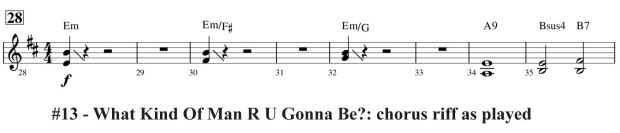
- m.28-35: this is the chorus section. I played power chords with glissandos as shown below and did the same thing every time this section appeared (m.26-43, m.72-79 and m.80-87).
- m.88-111: as the score states, the accenting varies throughout this 1/8-note rhythm section. Pay attention to the accenting. Keyboard 2 has a solo from m.104-111 but since we had no Keyboard 2 I took a solo here (I did something similar to the keyboard solo on the cast recording). It seemed to work pretty well.
- m.136-138: I played power chords here.
- m.140-145: I played a different inversion for the descending Fm arpeggios, an octave higher and descending from C as shown below. I thought this was more effective and made the part pop out more.

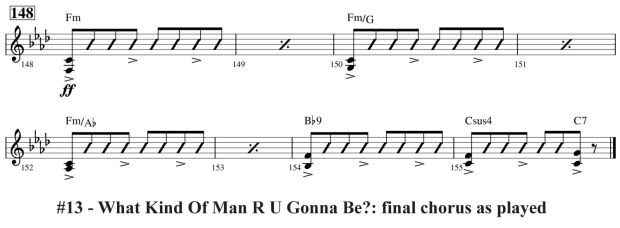
- m.148-155: I played low voicings of 2-note power chords for the big finish to the song, as shown below. Cut off cleanly and suddenly at the end of m.155. It’s a complete dead stop.
#14: Viola’s Soliloquy (Reprise)
A short reprise as Viola finds out that Sebastian (her brother) may still be alive. This is all texture: chords with volume swells throughout. I played it as written with low voicings throughout, except that where a B chord is called for in m.2,4 and 6 I played a Bsus2 (it sounded better and is consistent with the original version of the song (#6: Viola’s Soliloquy).
Pickup: Neck + Bridge
Effects: delay, reverb, tremolo throughout.
#15: Greatness
Malvolio laments the world’s inability to recognize his greatness from inside a portable toilet (don’t ask!). It’s basically an ode to self-pity. This is the only Malvolio number for which I didn’t use a Tenor Banjo. I played it as written.
Pickup: Bridge
Effects: m.27-40: delay, reverb, tremolo / m.41-71: delay.
Tips/adjustments:
- I used volume swells and 5th fret voicings for the chords in m.27-34.
- m.69-71: I played high voicings at the 7th fret.
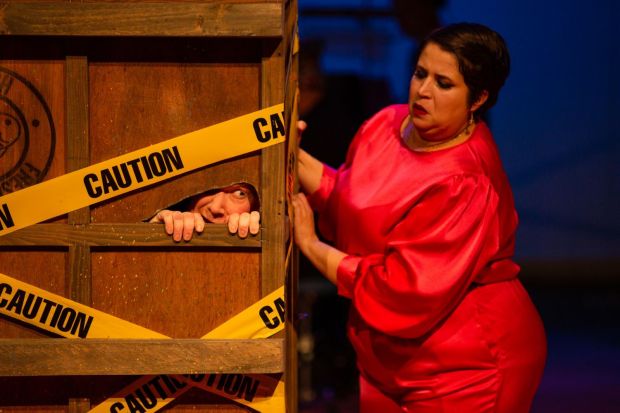
“Greatness”. Image courtesy of Seattle Shakespeare Company & © John Ulman Photography
#16: Sebastian’s Soliloquy
A brief number, but the chart is a mess. Almost every note either has the wrong duration, the wrong pitch or both. I include a corrected chart below, which can be downloaded here. There is a direct segue into #17: Word On The Street III.
Pickup: Neck + Bridge
Effects: m.1-2: delay, reverb / m.14-17: none.

#17: Word On The Street III
The final appearance of the Word On The Street theme. It’s all funky rhythm playing and I took the opportunity to try a few more complex syncopations here. Turn off the envelope filter for the last measure and slide up to a high (9th fret) voicing of B Maj7 to close out the number. If you are using a fold-out page for #23: Eyes Of Another, the end of this number is a good time to open it, because from #18 onwards the music doesn’t stop for long.
Pickup: Neck + Bridge
Effects: m.1-20: envelope filter / m.21: none
#18: Viola’s Soliloquy (2nd Reprise)
Another reprise as Viola and her brother are finally reunited. This is very similar to the first reprise (#14): all texture and volume swells.
Pickup: Neck + Bridge
Effects: delay, reverb, tremolo throughout.
Tips/adjustments:
- m.1-8: I played voicings on the four high strings for the chords, starting with G#m at the 7th fret, descending to C# at the 4th fret.
- m.16: error. The chord should be A9, not Dm/A.
- m.17-24: I played lower voicings, mainly on the D, G and B strings for these chords.
- m.31: error. The chord should be AbMaj7, not Ab(#11). I actually played AbMaj7(add 9), which sounds lovely (6th fret, Ab-Eb-G-Bb).
#19: Tell Her (Reprise)
Instrument: ukulele
The score calls for “dreamy but precise chords in any inversion”. There’s a sort of steady pulse to this number. I played the rhythm exactly as written, using the voicings shown below, which always keeps an Ab at the top of each chord, contributing to the “precise” feel.
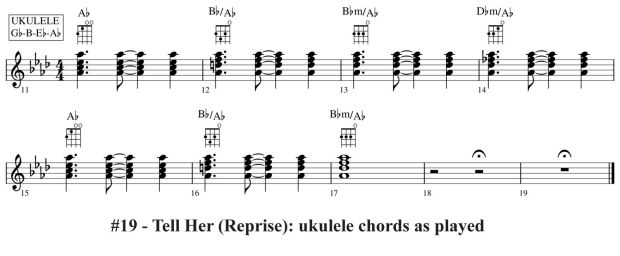
#21: Malvolio’s Exit
Instrument: electric guitar (or tenor banjo, no capo)
A reprise of #15: Greatness. Malvolio realizes he has been made to look a fool, and vents before storming off in a huff. This was another instance where the absurdity of the action on stage suited a tenor banjo. If I had been using a guitar I would have used Bridge pickup and no effects, but a tenor banjo worked much better. I played the number as written, transposing only m.13 and m.15 up one octave to suit the range of the banjo.
#22: Is This Not Love (Reprise)
Everyone falls in love (except Malvolio, obviously) and lives happily every after. The idea here is to have a big finish to the show and the guitar part is basically power chords to get a “rock ballad” feel.
Pickup: Neck + Bridge
Effects: overdrive and delay throughout.
Tips/adjustments:
- I played 2 or 3 note power chords throughout.
- m.5-16: I played whole note chords for this section (except in m.13, where I played the root notes only).
- m.17-28: I played a slightly busier rhythm (but not much – just feel the number, and as the score says, try not to be attention-grabbing).
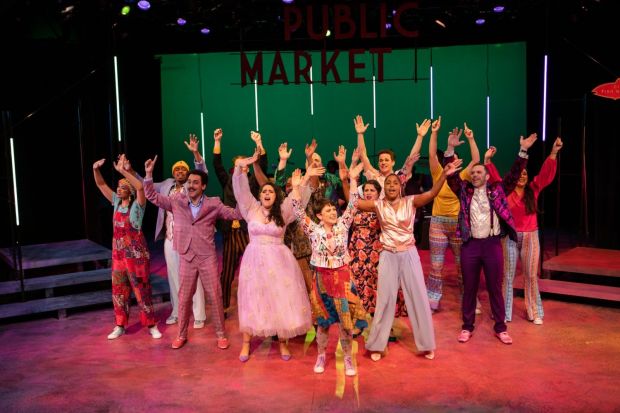
“Eyes Of Another”. Image courtesy of Seattle Shakespeare Company & © John Ulman Photography
#23: Eyes Of Another
A feelgood funky singalong tune to close out the show. You have a lot of latitude in how you play this one. Think of the chart mostly as a lead sheet. However, there are a few things you need to hit precisely, and the chart has some errors, as identified below.
Pickup: Neck + Bridge
Effects: none.
Tips/adjustments:
- m.23-24: error. hit the Cm/G chord on the last 1/8-note of m.23, not the downbeat of m.24 (i.e. anticipate the beat. This is the first of several such errors in the chart.
- m.28-29: error. hit the Ab chord on the last 1/8-note of m.28, not the downbeat of m.29.
- m.30-47: the chart calls for envelope filter wah. I ignored this and recommend that you do too. It doesn’t sound great.
- m.48-49: error. hit the Cm chord on the last 1/8-note of m.48, not the downbeat of m.49.
- m.53-54: error. hit the Ab chord on the last 1/8-note of m.53, not the downbeat of m.54.
#24: Bows
An upbeat, jazzy reprise of #1: Play On
Pickup: Neck + Bridge
Effects: none.
Tips/adjustments:
- m.2-16: I played in a similar style to the opening of #1: Play On (specifically m.30-46).
- m.22-29: I played with a jazz comping feel to accompany the horns’ solos. You may be asked to play a solo here.
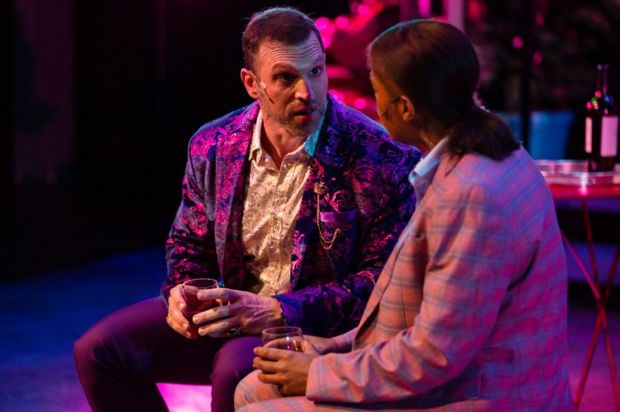
“If You Were My Beloved”. Image courtesy of Seattle Shakespeare Company & © John Ulman Photography
LINKS – OTHER ARTICLES ON THIS SITE
Twelfth Night – A Joyful Return To Musical Theatre
List of errors in the Twelfth Night Guitar book
Charts
#1a: “Play On” Play-Off – corrected chart
#5: If You Were My Beloved (Reprise) – chart transcribed from original cast recording
#6a: On The Street Transition – chart of my guitar solo for this brief scene change number
#7a: You’re The Worst Tag – detailed chart including chord voicings
#12: Count Malvolio (Reprise) – optional extra (Guitar is Tacet in original book)
#16: Sebastian’s Soliloquy – corrected chart
LINKS – EXTERNAL
Note: all links were valid at the time this article was published.
Twelfth Night (play) Wikipedia
Shaina Taub homepage and Bandcamp page
Mike Brun homepage (orchestrator, arranger & original guitarist for the show)
Twelfth Night musical demos (Bandcamp)
Original cast recording CD and YouTube playlist
Seattle Shakespeare Company
ACKNOWLEDGEMENTS
I am grateful to the incomparable R.J. Tancioco for once again hiring me to play for an unusual and interesting project. Thanks also to the Seattle Shakespeare Company, and to the cast, crew and band for the show, all of whom made working on Twelfth Night a truly uplifting experience. I am also grateful to Mike Brun, who orchestrated the show (and was its original guitarist) for answering my questions on the scores for both Twelfth Night and As You Like It.

 STRUMpit
This is terrific stuff. (I’m not a guitarist though…) I’ve been asked to play bass on a production of this and ran across this page. Thanks for all the insight.
LikeLike
Thanks Dwayne. You should take the offer. Twelfth Night is a lot of fun to play and the abbreviated script really brings out the comedy.
LikeLike
As MD for Twelfth Night the Musical opening in the UK with Thalian Theatre Company on May 21st may I say thank you for taking the time to share your experience and knowledge.
LikeLike
Thanks and you’re welcome. Good luck with the production. It’s a lovely show.
LikeLike