Playing Sister Act, The Musical – Guitar
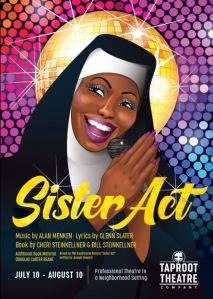
Music: Alan Menken
Lyrics: Glenn Slater
Book Cheri & Bill Steinkellner
Year: 2009 (Original West End production), 2011 (Broadway)
I spent much of summer 2024 playing Sister Act at Seattle’s lovely Taproot Theatre. It was a long, well-reviewed and joyful run of shows. Every performance was full, the run was extended and each night the departing audience was a sea of smiles. But then, what’s not to like about disco nuns? Taproot is a small theatre but hired an absolutely A-list cast for the production, led by the wonderful Alexandria J. Henderson. Performing a really high-quality show in such an intimate setting is a particular treat; there’s an immediacy to the connection with the audience which can’t be achieved in a larger house.
In this article I briefly describe the show and its development, reflect on my experience playing it, offer some general observations on the Guitar book and my approach to playing it and discuss the orchestration in general. I also describe in detail the equipment I used to play the show. In a separate article (coming soon) I provide a detailed song-by-song commentary on the Guitar book, which will be useful to anyone preparing to play the show.
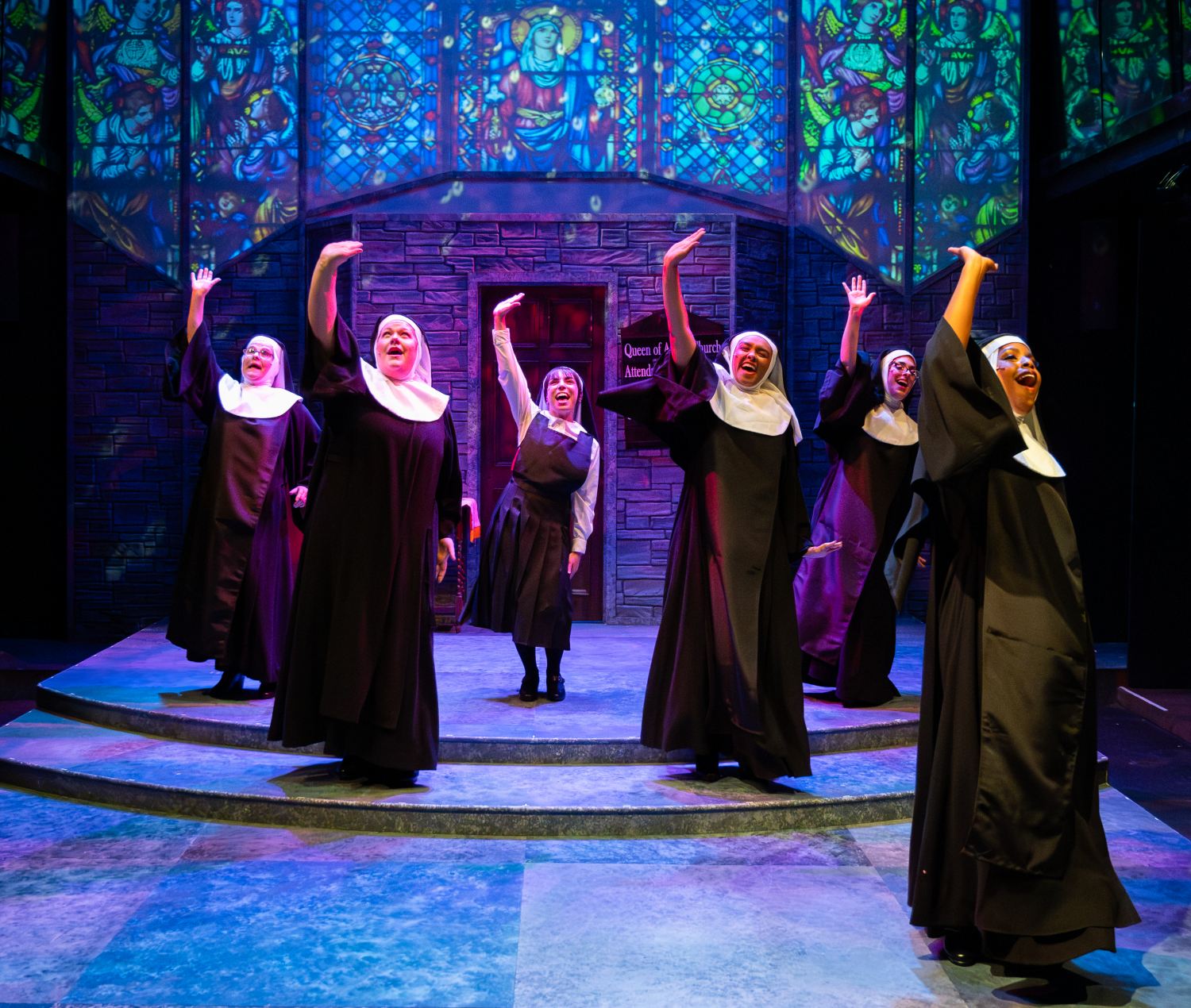
Disco Nuns – what’s not to like? ♦ Image courtesy of Taproot Theatre and © Michael Wade Photography
THE SHOW
Sister Act is a 2009 musical comedy with songs by Alan Menken and Glenn Slater, based on the successful 1992 Whoopi Goldberg film. It tells the story of Deloris van Cartier, a lounge singer forced into Witness Protection after seeing her mobster boyfriend commit a murder. She hides in a convent and converts the struggling nuns’ choir into a successful disco/gospel ensemble, saving the struggling convent from closure. The plot serves as a backdrop for Deloris’ journey of self-discovery and her developing relationships with the nuns, particularly the crotchety Mother Superior. Ultimately, the show’s main messages are that what you think you want (or need) may not be what you really need, as both Deloris and the Mother Superior discover, and that the things which appear to divide us can sometimes bring us together, or are just different ways of looking at the same thing. If that sound a bit deep and meaningful, don’t panic. Sister Act is first and foremost a light-hearted comedy; it’s a really good time (having said that, a few of the 2009 jokes land a little awkwardly in 2024!)
While the show’s plot is similar to the movie, there are some major changes, the most significant of which is the music. The movie has the nuns singing 60s pop tunes with altered lyrics, and has a soundtrack of other 50s and 60s pop music. Instead of making it a jukebox musical, Alan Menken wrote a bunch of disco, funk and Philadelphia soul songs – it’s all original. In support of this new musical style the movie’s 1992 San Francisco setting is changed to 70s Philadelphia. Broadly speaking, Deloris’ and the nuns’ choir songs are disco, the gangsters are Philly soul-influenced and the “life in the convent” songs are typical Broadway tunes.
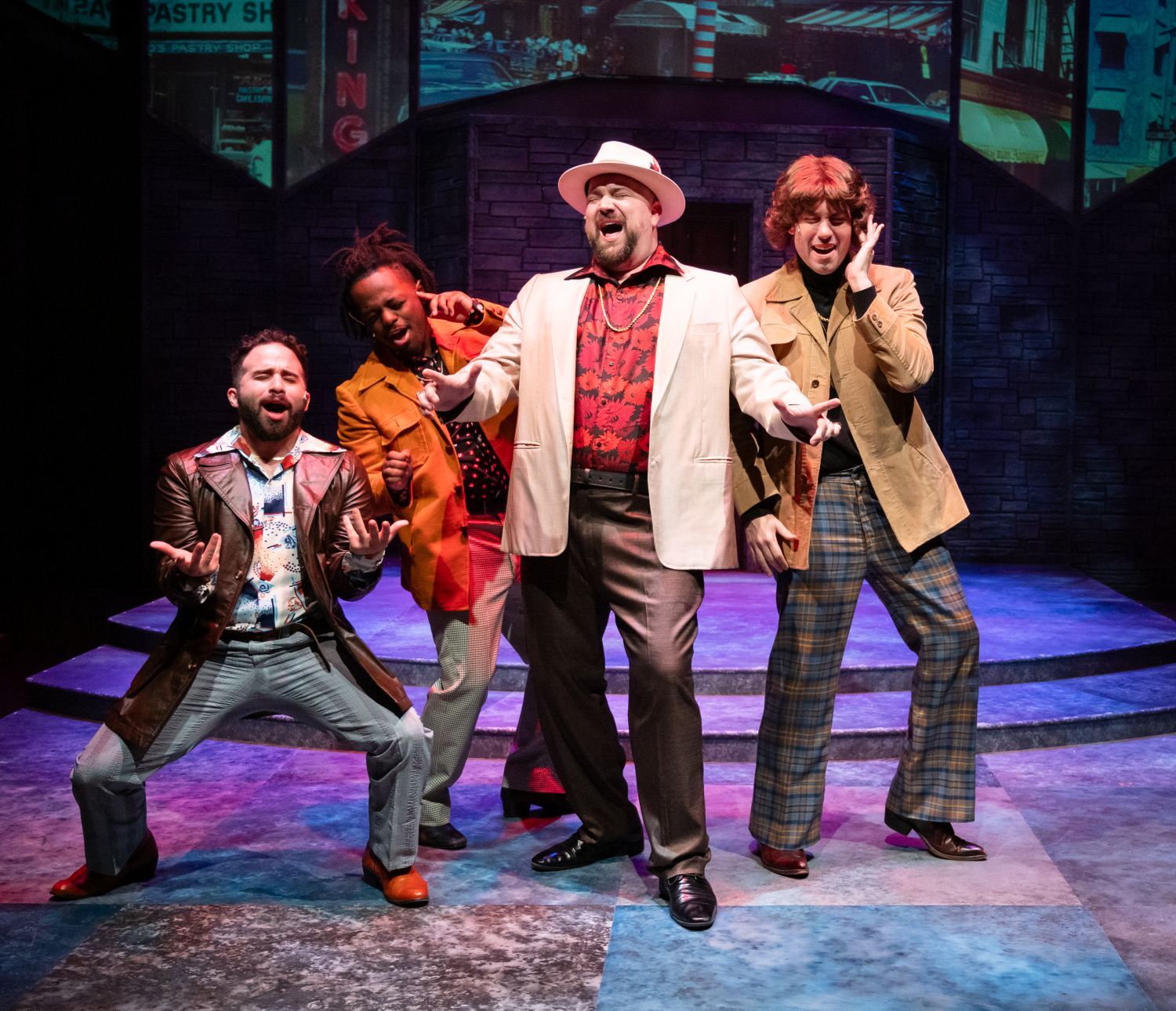
Curtis and his gang – “When I Find My Baby” ♦ Image courtesy of Taproot Theatre and © Michael Wade Photography
The show premiered in Pasadena, California in 2006, where it became the highest grossing production ever at the Pasadena Playhouse. After a further run in Atlanta in 2007, the show moved to the West End, opening at the London Palladium in 2009, where it ran for 17 months. A round of revisions to the show was made before its Broadway opening in April 2011. It ran there for 16 months, followed by a National tour from 2012 to 2014.
The revisions between London and Broadway, included changes to the music. The song “How I Got The Calling” keeps most of its music but has a new lyric, becoming “It’s Good To Be A Nun”. Deloris’ song from the dive bar scene is eliminated (“Do The Sacred Mass”). The Mother Superior gets a new song in Act 2 (“I Haven’t Got A Prayer”). There is a London cast recording, but no Broadway cast album was made, which means that there isn’t a recording which exactly matches the current score for the show.
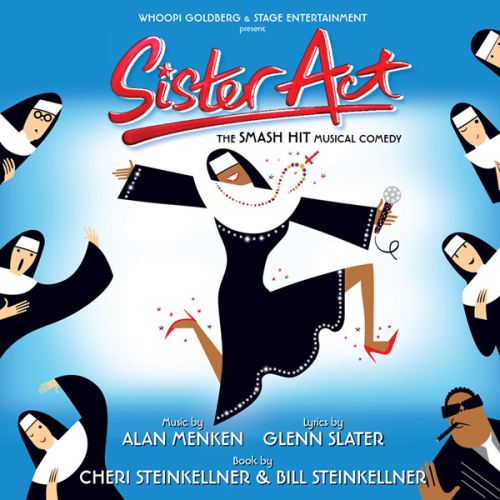
Sister Act, Original West End Cast Recording Artwork
PLAYING THE SHOW
Sister Act is tremendous fun to play. It’s a long show (each act is about 75 minutes) but never drags; the music comes at you fast with only a few longer (and very funny) scenes between. The show doesn’t outstay its welcome. Each act begins with a chunk of disco/soul music, followed by some more typical Broadway production numbers and then more disco. About three-quarters of the music falls into the disco/soul category. There’s a lot of rhythm playing and many of the tempos are fast, which means that the show is quite physically demanding to play. Even though I was well rehearsed, I found that my funk rhythm playing improved noticeably during the run; by the end I was playing more tightly, comfortably adding more elaborate syncopations that I would not have attempted initially. The idea with this music is not to stand out, but to be “present” in the ensemble sound, and support and enhance the overall groove.
ORCHESTRATION
Sister Act is licensed via MTI, and two orchestrations are available. The Standard Orchestration is from the US post-Broadway tour, scored for a 12-piece ensemble (Bass, Drums, Percussion, Guitar, 3 Keyboards, 2 Reeds, 2 Trumpets & Trombone). The “alternate” version is the full 17-piece Broadway orchestration which adds a third Reed, a second trombone, Cello and 2 Violins.
All of this is to say that this is a pretty large show, and all but the largest theatres are likely to opt to reduce the size of the orchestra. The size of orchestra depends not only on the available budget, but the size of the theatre in which the show is performed. At a bare minimum, you could perform the show with Drums, Bass, Guitar and two Keyboards, but that might sound a bit thin in a larger house. The production I worked on had only 4 musicians:
- Drums, also covering as much of the Percussion book as possible.
- Guitar
- Keyboard A, playing basically the Piano rehearsal score, plus a bunch of bass.
- Keyboard B, playing a specially prepared book covering the most important parts of all other books, plus a bunch of bass (this book required a lot of keyboard programming).
The approach worked very well, partly because the show was performed in a small 226-seat theatre, and partly because of the calibre of musicians playing the show (I get to hang out with the best people!).
The full orchestra often comes across as a glitzy and slightly inauthentic take on the Philadelphia Soul sound, but as the size of the orchestra shrinks, the show’s signature sound gradually transforms into something closer to a 70s soul/disco combo. I think this punchy, grittier sound suits much of the material better. If you are going for a smaller ensemble, it pays to lean into the idea of a tight funk combo with keyboard embellishments, rather than thinking of it as an orchestra stretched thin. However small the band, I don’t recommend eliminating the Bass book; a 5-piece ensemble should really be the minimum. The size of the ensemble also has an influence on the approach to playing the Guitar book, as I explain below.
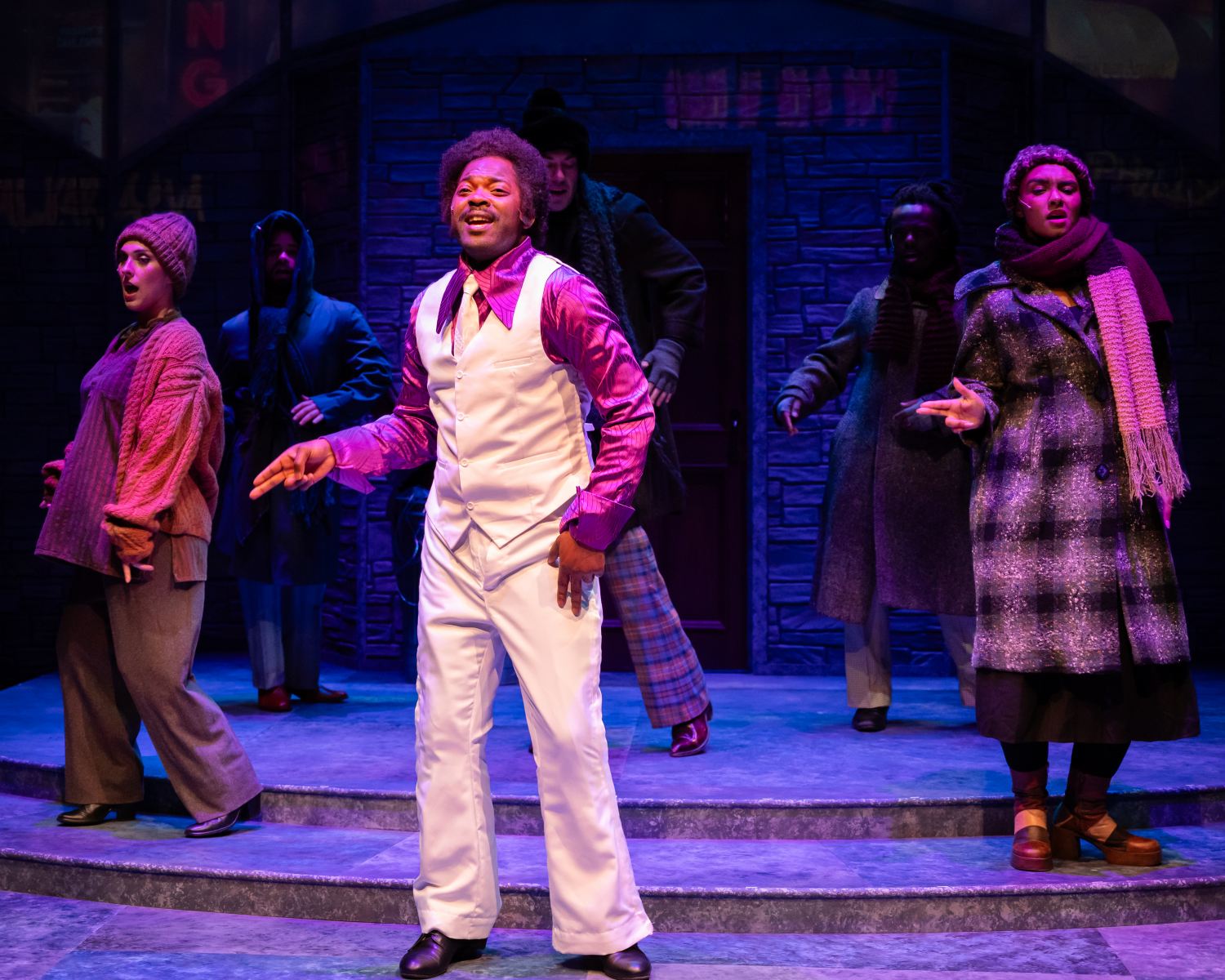
Office Eddie Souther – “I Could Be That Guy” ♦ Image courtesy of Taproot Theatre and © Michael Wade Photography
GENERAL NOTES ON THE GUITAR BOOK
The Guitar book is long, containing 108 pages of music. Alternate key versions of five numbers are provided; annoyingly they are located at the end of the book. The first thing I did was to move the alternate versions to the appropriate places in the book (and we did actually use one of them).
The book requires Electric, Acoustic and Nylon-string guitars. The Acoustic and Nylon-string are used in the “Broadway” production numbers in the middle section of each act (songs sung by the nuns in the convent), whereas all of the disco/soul numbers use only Electric guitar (Deloris’, the gangsters’ and the nuns’ disco choir songs). Overall the book is 75% Electric guitar, 16% Nylon-string and 10% Acoustic.
Many of my blog articles reflect on the degree of vagueness or specificity of the charts provided for a show. Sister Act is a little different. The Acoustic and Nylon-string charts are mostly reasonably detailed and specific, whereas the Electric guitar charts are not, but for once this is not attributable to bad drafting; the charts are general in nature for practical reasons. So, what do you get?
Typically, the Electric charts use rhythm slash notation to provide the chords and chord changes as precisely as possible. You build an actual rhythm pattern around the chord changes to suit the groove of the song. I provide an example below.
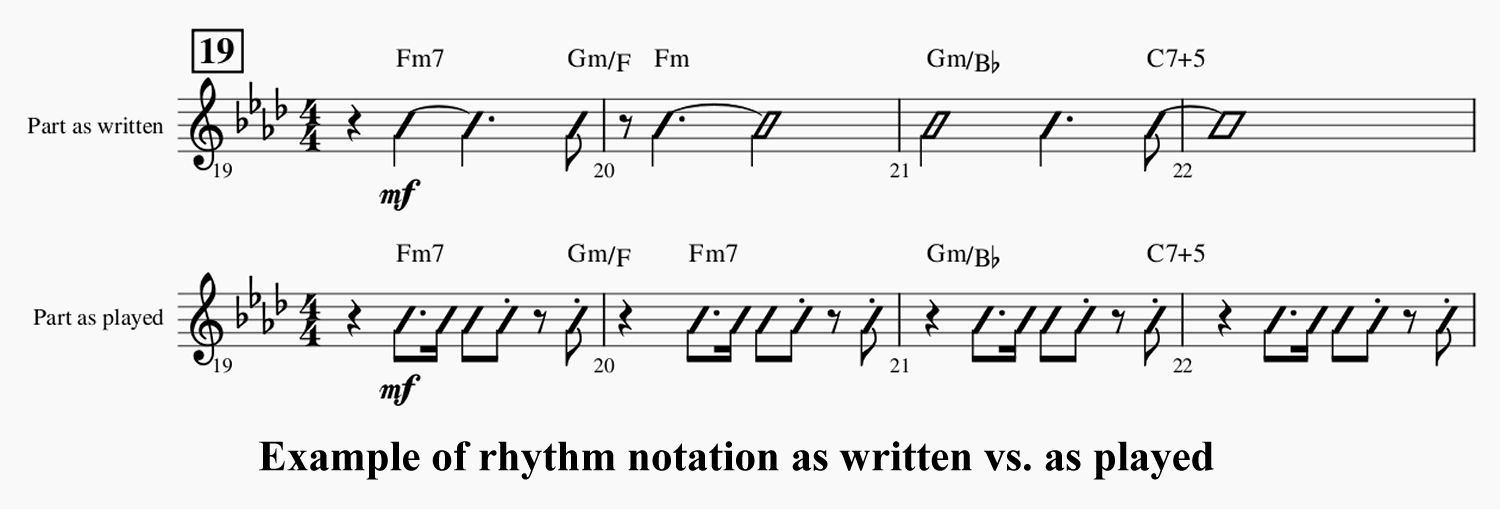
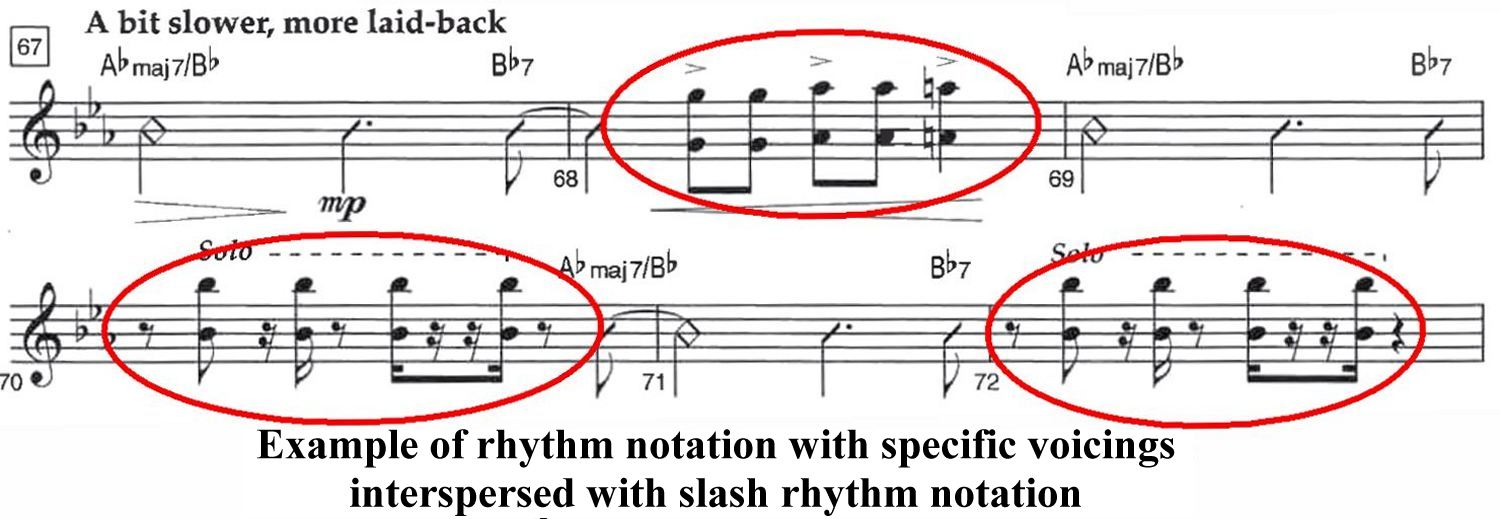
Specific voicings, notation and rhythm are provided as needed throughout the book, as shown in the example below.
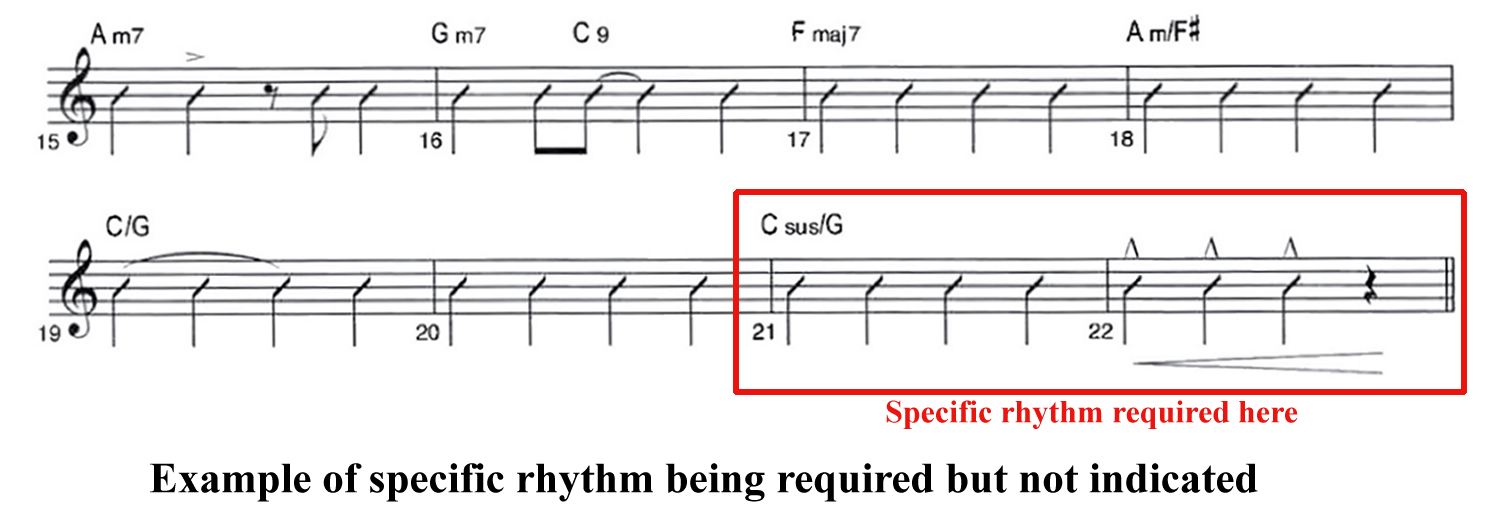
Frustratingly, there are a lot places in the book where you actually need to play the rhythm exactly as written to fit into the overall arrangement, but this is never indicated – you have to work out where these spots are by trial and error as you rehearse the show. Here’s an example:
There are a few solo guitar spots, but really, this is 99% ensemble rhythm playing. I provide a lot more advice on how to interpret the charts in my companion article, Sister Act – Detailed Notes on the Guitar Book (coming soon).
There are pros and cons to the charts being written in this way. On one hand you have to do a fair amount of work to prepare for the show, mostly in working out appropriate and ergonomic chord voicings and progressions. On the other hand, you have a lot of latitude to make the performance your own, probably more so than any other book I have played. Another benefit of these very general charts is that you can shape your interpretation of the material to suit the size of the ensemble. You are likely to choose slightly different voicings for a 5-piece combo than for a 12- or 17-piece orchestra, and the way the charts are written allows you to do just that.
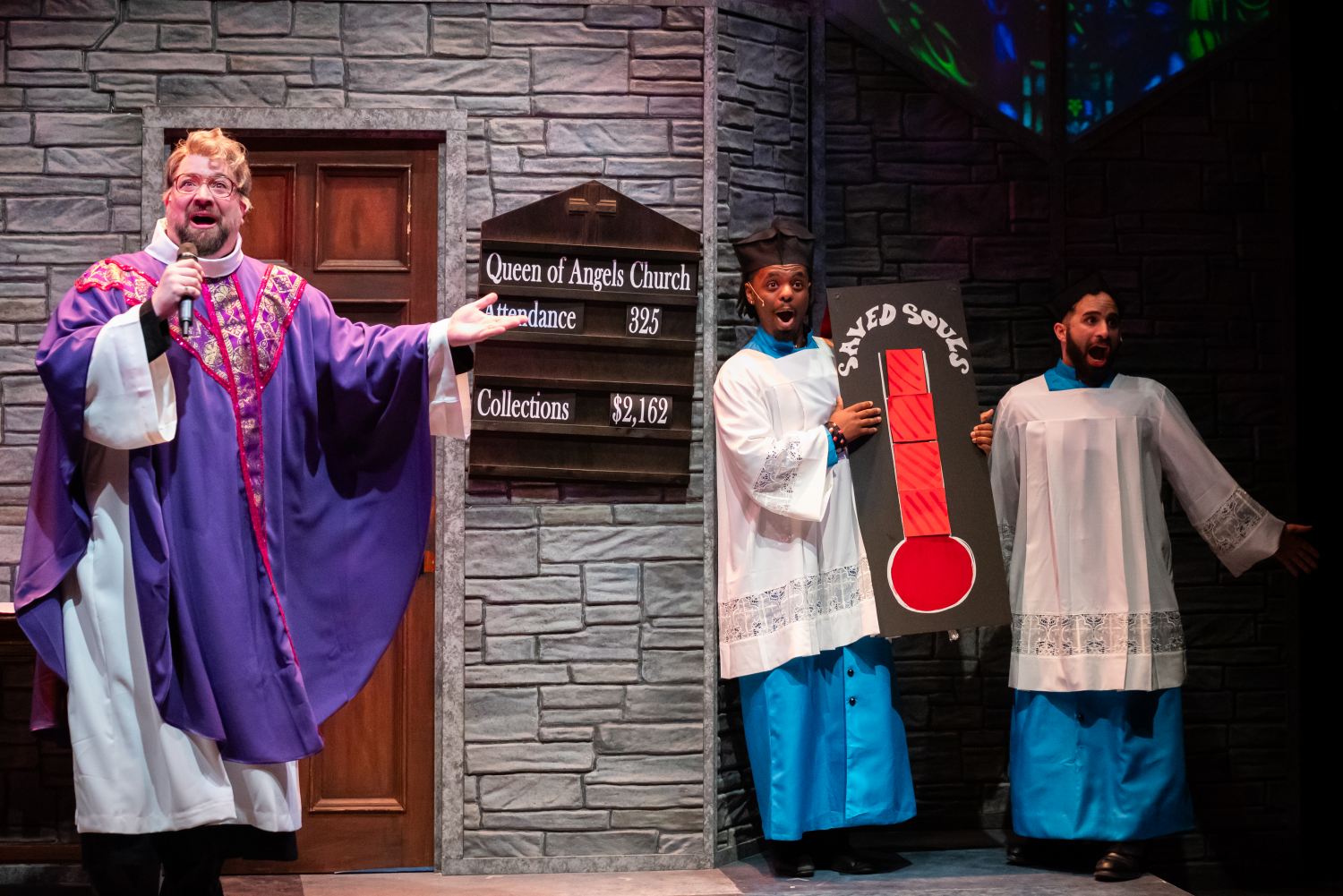
Monsignor O’Hara – “Sunday Morning Fever” ♦ Image courtesy of Taproot Theatre and © Michael Wade Photography
EQUIPMENT
Instruments
The score calls for Electric, Acoustic and Nylon-String Guitars. I used the following:
- Electric: 2022 Gibson Les Paul Standard. 1970s disco and soul records made extensive use of Gibson electrics (mainly Les Pauls and ES-335s). While some funk players use Fender Stratocasters, this is definitely a score that calls for the warm sounds of PAF-style humbuckers. It was the first outing for my recently-purchased Les Paul and I was very pleased with the way it performed (although it is very heavy!). I used my 1974 ES-335 TD as a standby guitar, because so much of the score is Electric Guitar, and there isn’t time to change a string.
- Acoustic: 2004 Atkin Guitars Small Jumbo. This custom-built instrument by Atkin Guitars has been my go-to acoustic guitar for a long time. It has a Fishman Matrix Infinity piezo pickup, which I use with a Fishman Aura Spectrum modeling preamp to get a more natural sounding acoustic tone (see notes on amplification and effects below).
- Nylon-String: Takamine P3FCN. Another favorite guitar that I have used for about 11 years, the Takamine P3FCN is a modern take on the classical guitar, with a smallish, cutaway body. It incorporates one of Takamine’s modular pre-amps, and I have replaced the stock 9V model with the excellent 18V CT4-DX.
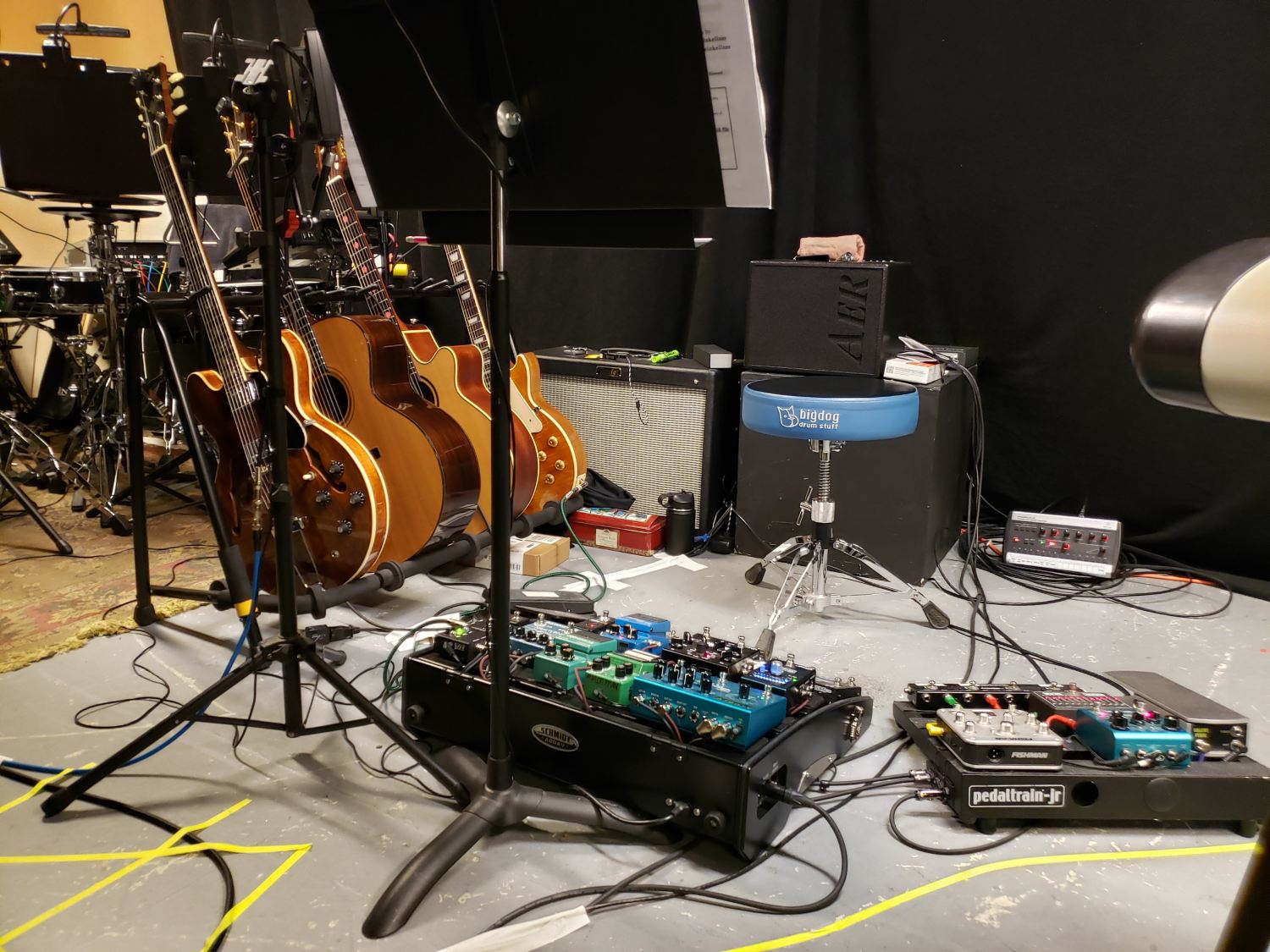
Guitar equipment setup for Sister Act at Taproot Theatre, 2024
Amplification
Electric guitar: this production was the first outing for my new electric pedalboard, which incorporates on onboard amplifier, the DSM & Humboldt Simplifier Mk.2. I had been using the Simplifier Mk.1 for several years as a DI but had never been completely convinced by its preamp tones. Nevertheless its versatility makes it a very useful pedal. The Mk.2, I am pleased to report, is a huge tonal upgrade.
The new pedalboard (more details below) allows me to switch between an outboard tube preamp or the Simplifier via an A/B switch, with no rewiring needed. I used the Simplifier, voiced for a Fender-style tone, as the preamp. I routed the ¼-inch out to my Fender Hot Rod Deluxe power stage (Effects Return) with no cab simulation added to the signal. Simultaneously the signal was routed via a cab simulator and one of the Simplifier’s two XLR outputs to the house mixing desk. The full signal chain is described below, but the basic amplification solution is that the Simplifier provided the tone, the Fender amp was my personal monitor and the Simplifier signal with cab simulator was what was heard in the house.
This was my first production in a while which used live audio monitoring instead of an in-ear mix; I have to say it feels like a much more natural way to play and I enjoyed it a lot. We just felt more like a band.
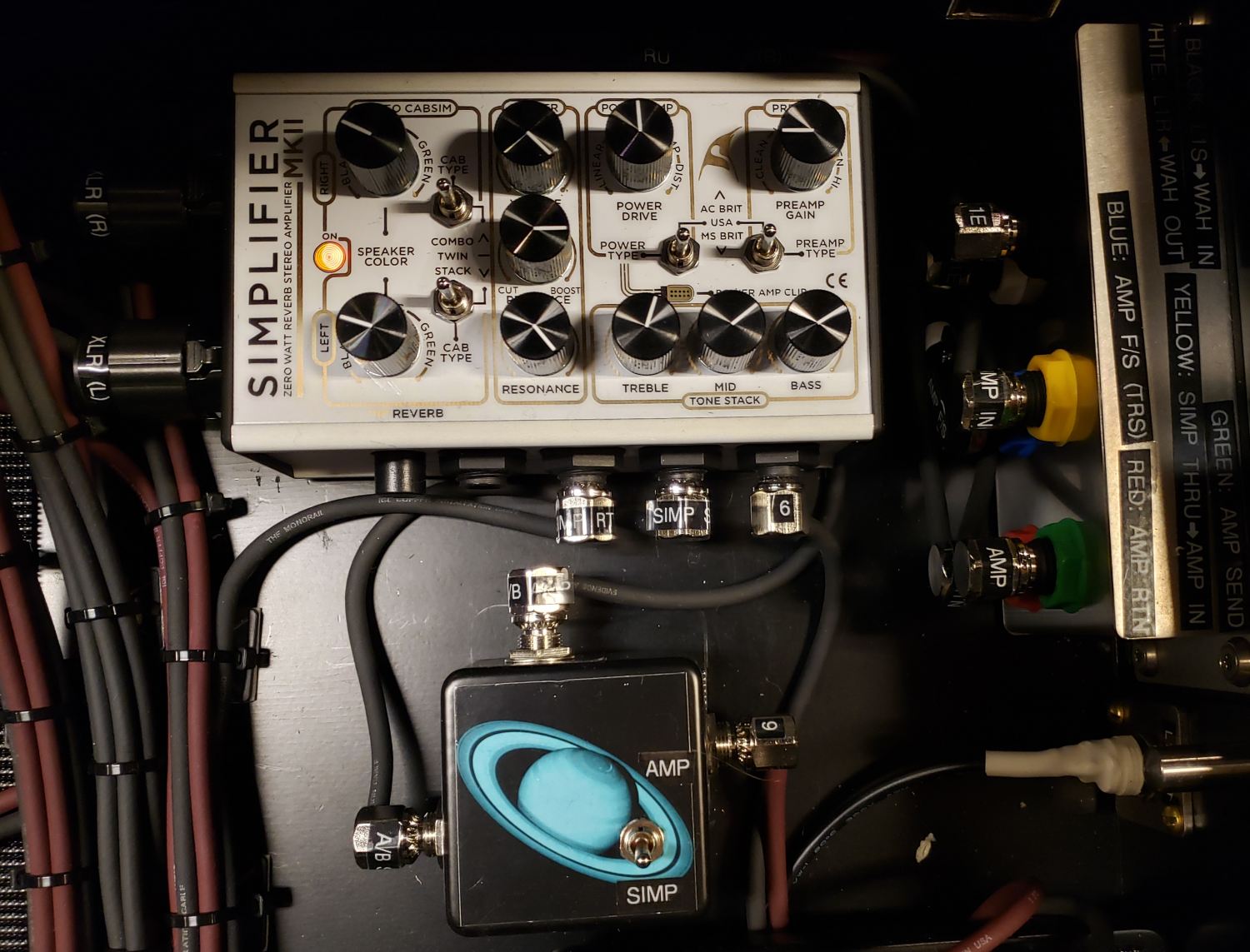
DSM & Humboldt Simplifier Mk.2 onboard amplifier and amp selector A/B switch
Acoustic instruments: I used an AER Compact 60/4 to amplify the acoustic instruments. All of the instruments came into the amplifier via a single output from the pedalboard switching system. I kept the EQ on the amplifier flat, EQ-ing & balancing the instruments against each other on the pedalboard. The Compact 60 has an XLR out so it works as both a DI and a personal monitor. AER are a German company, and these robust amps are very high quality. Details of the signal chain are provided in the section on pedalboards below.
I have used the Mk.3 version of this model for years but decided to make an upgrade for this show. The Mk.4 is very similar to its predecessor, but overall has a slightly warmer and more natural timbre. It also has the new option to add reverb and the on-board effects into the signal sent via the XLR out.
Effects
Electric Guitar: as mentioned above, this was the first time I played a show using my new pedalboard. I designed and built the board specifically for use in musical theatre, and it incorporates a number of novel and useful features. I plan to make the board’s design the subject of a separate article, but for now it suffices to say that it is built around the GigRig G3S switching system, which I believe to be the finest available.
Each pedal is plugged into a loop on the G3S and you program presets on the G3S, so that changing sounds is simply a matter of pressing one of the G3S’s footswitches. The G3S is also MIDI-enabled, as are the board’s EQ, delay and reverb pedals. I was able to use MIDI Program Change messages sent by the G3S to change settings on these three pedals as needed for any preset.
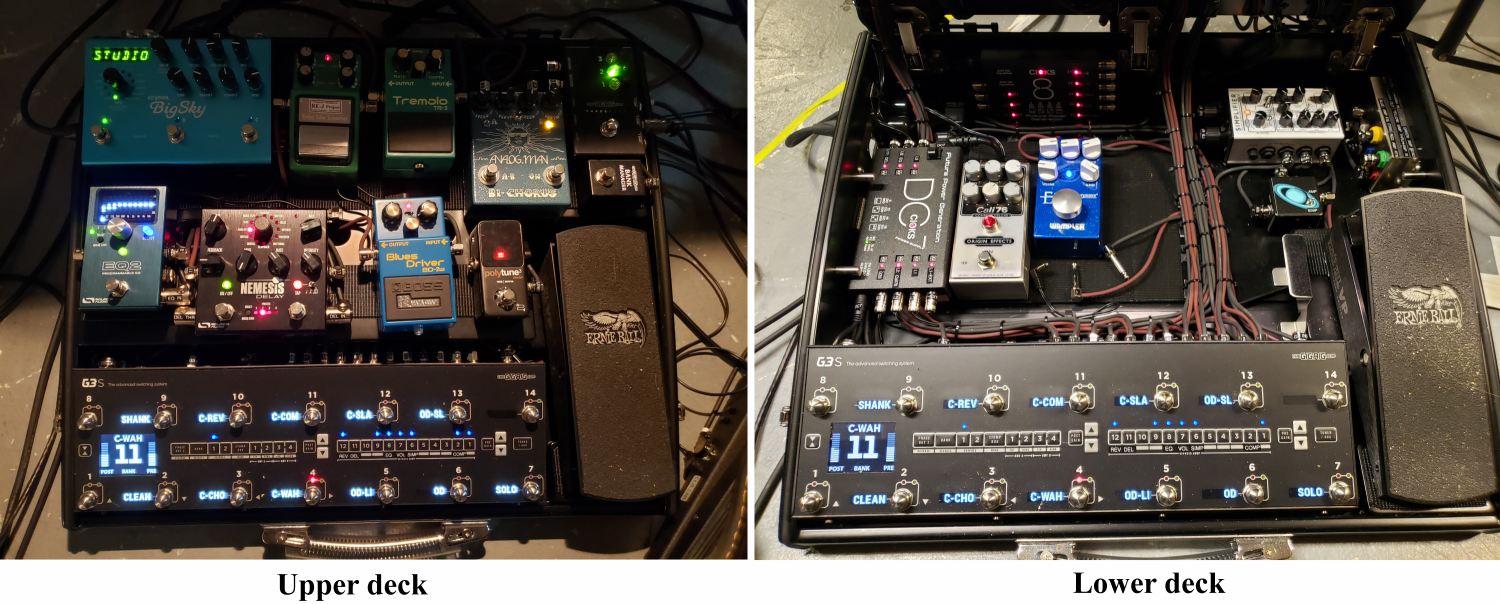
Sister Act electric guitar pedalboard, 2024
In addition to the Simplifier on-board amplifier, I used the following pedals:
Wah – Dunlop Cry Baby 535Q Multi-Wah: this versatile wah is “tunable”, so that it can sound like many different wah pedals. I dialed in a tone to get the classic disco “waka-waka” sound. This pedal gets a lot of use in Sister Act!
Compressors – Origin Effects Cali76 Compact Deluxe & Wampler Ego: I used the Cali76 as a subtle “always on” compressor for a lot of tones, and the Wampler just for a more sustained tone on “Lady In The Long Black Dress”.
Overdrives – BOSS BD-2w Waza Craft Blues Driver & Ibanez TS9DX Tube Screamer, with AnalogMan mods: the Tube Screamer was my go-to Overdrive, for just a tight, mid-range light overdrive. The Blues Driver was used just for a very slight break-up tone on “Lady In The Long Black Dress”.
Volume Pedal – Ernie Ball VP Jr. 40th Anniversary: every musical theatre pedalboard should have a volume pedal.
Graphic EQ – Source Audio EQ2 Programmable: I used a few different EQ settings to tweak tones on various presets. There were no dramatic EQ effects for this show.
Chorus – AnalogMan Bi-Chorus: the Bi-Chorus allows you to switch between two separate chorus settings. I used a very subtle setting for “Lady In The Long Black Dress” and a more classic disco chorus effect elsewhere (think Kool and the Gang).
Delay – Source Audio Nemesis: I used a few different delay settings, including a slapback, a 450ms single repeat for a lead tone and a subtle dotted quarter note for “Lady In The Long Black Dress”
Reverb – Strymon Big Sky: I used a smallish Room reverb throughout, except for the few occasions where I wanted a bigger sound, where I went for a Hall reverb. The Big Sky comes loaded with about a hundred presets which are good starting points for creating suitable reverb sounds. I used the very first two presets (“Studio Time” and “Great Hall”, modified to suit my tastes).
The BOSS TR-2 Tremolo visible on the board was not used.
Putting to one side the use of the G3S and its loops, the signal chain on an equivalent, conventionally wired board would be:
Guitar → Cry Baby Wah → Cali Compressor → Ego Compressor → Blues Driver O/D → Tube Screamer O/D → Volume Pedal → Simplifier preamplifier → Graphic EQ → Chorus → Delay → Reverb → Simplifier FX Return → Simplifier Cabsim → Simplifier XLR Out → house mix
The Simplifier ¼-inch out bypassed the cabsim and was routed to the FX Return of my Fender amplifier for monitoring purposes.
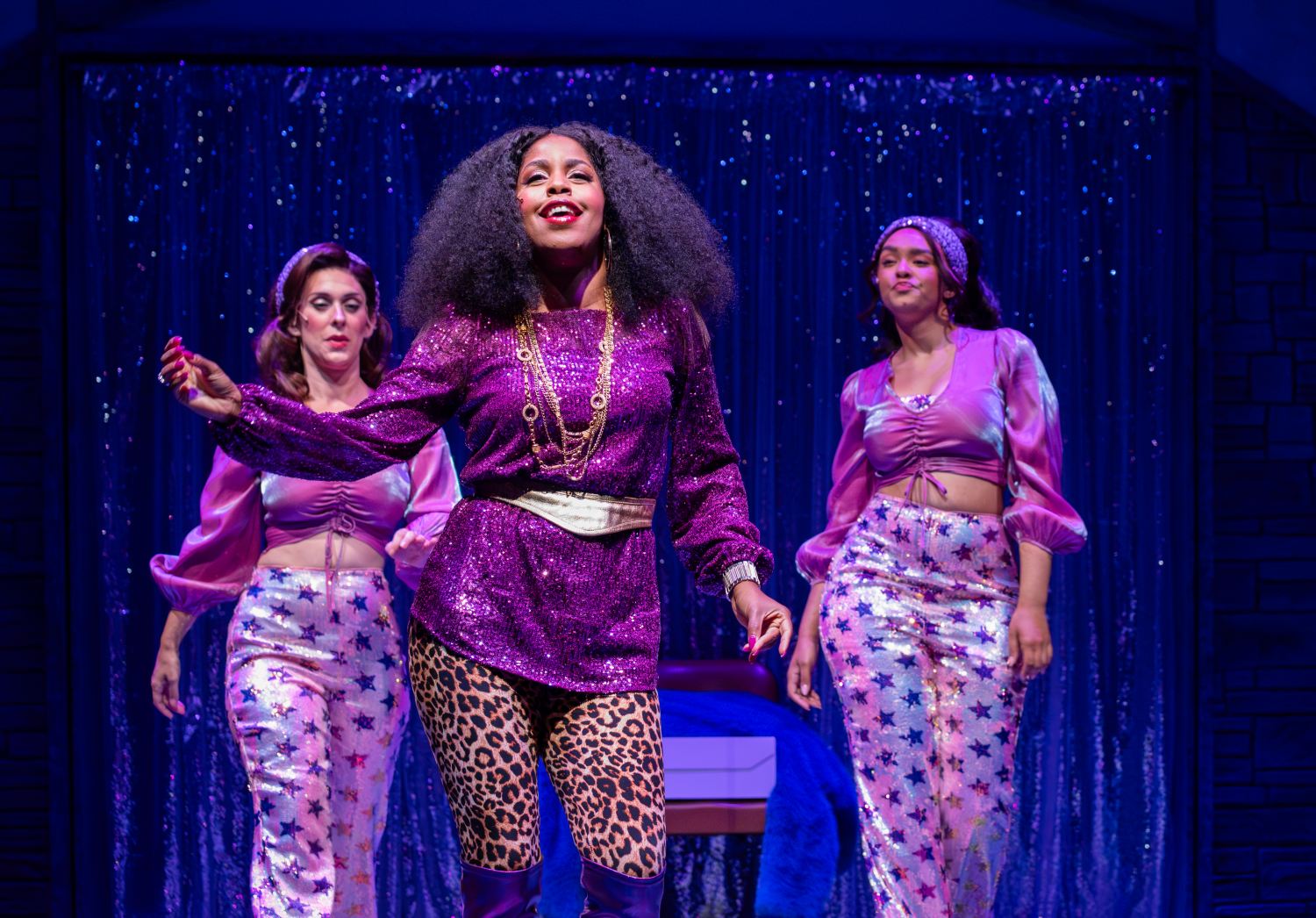
Deloris & her Singers – “Take Me To Heaven” ♦ Image courtesy of Taproot Theatre and © Michael Wade Photography
Electric Guitar Sounds
The guidance on guitar sounds in the Guitar book is pretty vague and (to my mind) not always completely appropriate. My advice to anyone playing the show is to trust your ears, listen to where you sit in the band mix and think about what works for the material when deciding what effects to use. Having said that, it is clear that for many of the rhythms a classic “disco chorus” or wah-wah sound is going to work well. I pre-programmed a set of sounds prior to the start of rehearsals, but ended up only using about half of my presets. Every sound was built on a “Fender clean” tone with a little EQ to finesse the sound; most had a little compression, and every tone had a subtle Room reverb (except for the few where I used the Hall reverb). In addition to these basics, the main tones I used were:
- Clean Chorus: the most-used sound in the show. Middle pickup, light chorus (think classic 70s disco).
- Disco Wah: also heavily used. Middle pickup, light chorus, wah pedal, compressor.
- Overdrive: middle or bridge pickup depending on the song, Tube Screamer (but not too distorted), compressor.
- Lead: I had a few brief solos in the show, at the request of the Music Director. I used the Overdrive tone, with some more boost, a slightly fatter sound (EQ) and a 450ms single delay (not mixed too high).
Other sounds were used sparingly as needed. I cover the sounds in more detail in my companion article, Sister Act – Detailed Notes on the Guitar Book (coming soon).
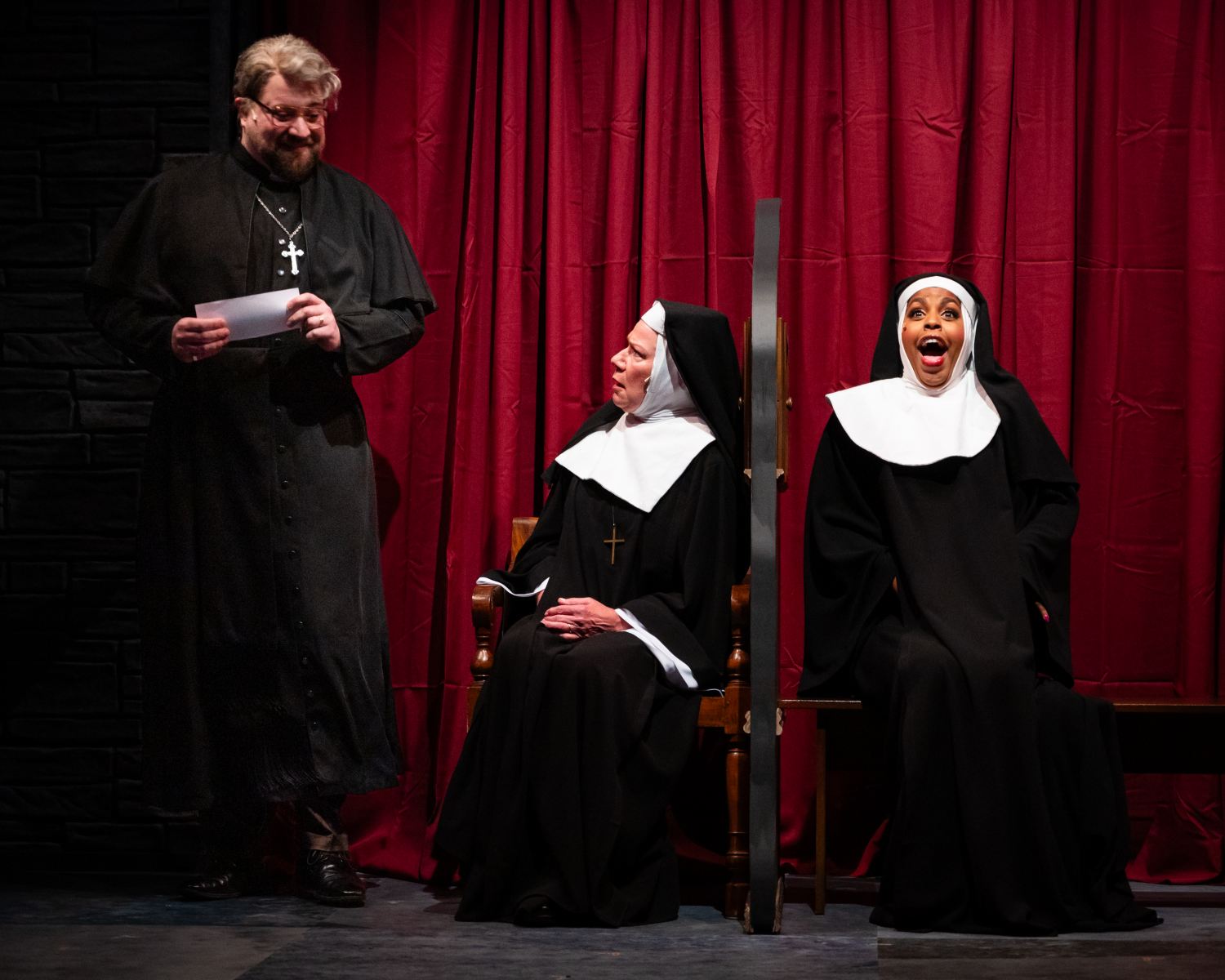
Confession Time… ♦ Image courtesy of Taproot Theatre and © Michael Wade Photography
Acoustic Instruments: I used what has become my standard pedalboard setup for acoustic instruments. The board is a Pedaltrain JR, powered by a CIOKS DC10 mounted beneath the board. Also mounted beneath the board’s right edge is a GigRig Cinco Cinco patch bay. All inputs and outputs are routed via the patch bay, which keeps the cabling neat.
The board has a GigRig Quartermaster QMX-4 switching system, for switching between instruments, an Ernie Ball VP Jr. volume pedal and a Strymon Blue Sky reverb, which is the best basic reverb money can buy, in my opinion. The QMX-4 switcher uses GigRig’s proprietary silent optical footswiches (no clicks!). The Blue Sky reverb was set to a fairly subtle room reverb throughout.
The general idea with the signal chain is that all instrument signals come into the board via the patch bay, then hit instrument-specific pedals, followed successively by the switcher, volume pedal, reverb, then back to the patch by and out to the Compact 60/4 amplifier. In summary:
[Instruments] → Cinco Cinco patch bay → [instrument specific pedals] → QMX-4 switcher → Ernie Ball VP Jr. Volume Pedal → Strymon Blue Sky reverb → Cinco Cinco patch bay → AER Compact 60/4 amplifier input → XLR out to house desk.
The instrument-specific pedals used were a Fishman Aura Spectrum for the steel-string acoustic, and an MXR M108 10-Band Graphic EQ for the nylon-string. Both of these pedals have gain control and EQ, allowing me to shape the instruments’ tone and balance them against each other. The Fishman unit also uses Impulse Responses to simulate a more natural acoustic tone.
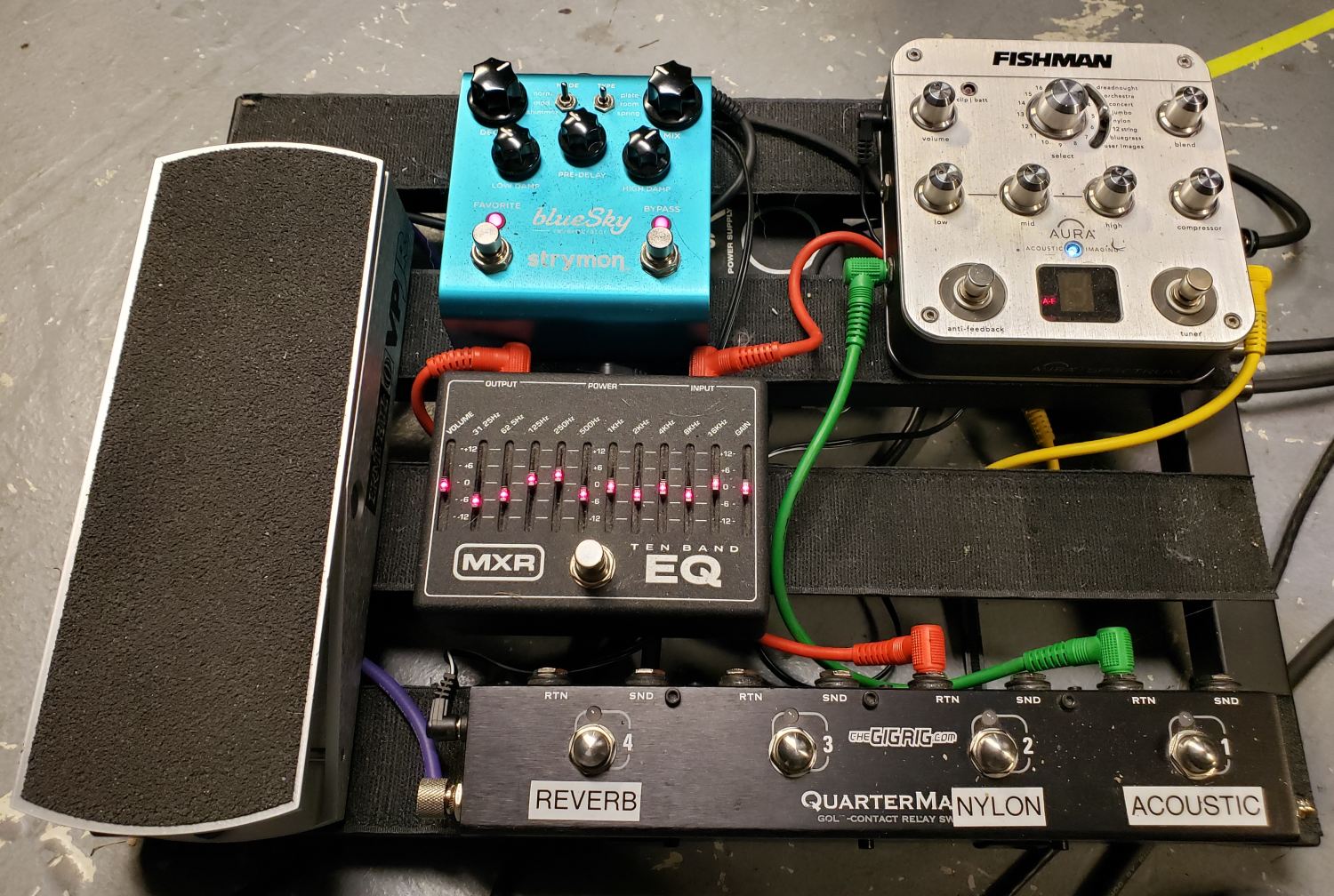
Sister Act acoustic pedalboard, 2024
Other Equipment
I used the following additional equipment:
- Manhasset Symphony music stand, with their plastic shelf attachment
- Aria Forte rechargeable LED stand light (I love this light!!)
- My Big Dog drum stool
- Hercules GS525B 5-guitar rack
- TC Electronics PolyTune 3 Noir polyphonic tuner (on electric guitar pedalboard)
- D’Addario Micro Guitar tuner (one on every headstock)
- Thalia capo for acoustic guitar
- Kyser classical guitar capo (for nylon-string guitar)
- Herdim 0.63mm yellow guitar picks (for electric guitar) – a fairly flexible pick suits the fast rhythmic playing required for this show.
- Dunlop 0.46mm standard nylon picks (for acoustic and nylon-string guitars)

Playing Sister Act, Taproot Theatre, 2024
LINKS – OTHER ARTICLES ON THIS SITE
Sister Act – Detailed Notes on the Guitar Book (coming soon)
LINKS – EXTERNAL
Note: all links were valid at the time this article was published
Sister Act (musical) Wikipedia page
Sister Act (original 1992 film)
Licensing information for Sister Act (MTI)
Original London Cast Recording YouTube playlist and CD
Taproot Theatre
Seattle Gay Scene review of Sister Act
Sound On Stage review of Sister Act
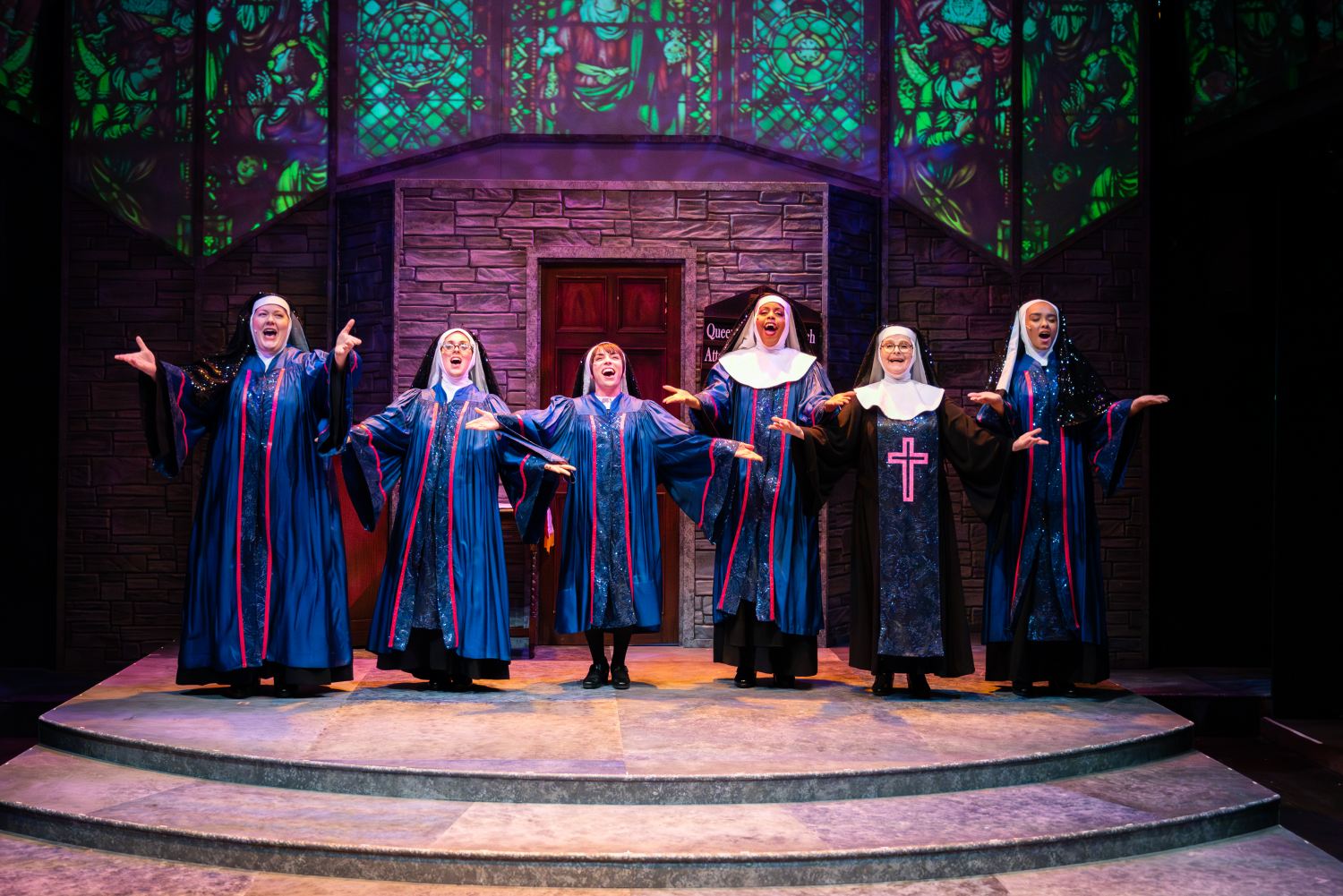
“Spread The Love Around” ♦ Image courtesy of Taproot Theatre and © Michael Wade Photography
ACKNOWLEDGEMENTS
I am grateful to Music Director R.J. Tancioco and Taproot Theatre for giving me the opportunity to be a part of a wonderful production of Sister Act. R.J. keeps hiring me for the most interesting projects and I am humbled by his confidence in me, because he is an amazing musician. Thank you also to my colleagues in the band: Scot Sexton (Drums/Percussion), Ben Bentler (Keyboards/Conductor) and Michael Matlock (Keyboards) for making this one of the friendliest pits I have ever worked in. Finally, I must acknowledge the terrific work of the stellar cast and crew; it was such a joy to play for and work with you all.

 STRUMpit